
Table of Contents
Introduction
Walk into any supplement shop and you will see the same promise on a hundred bottles: more energy, more muscle, better sleep, a sharper mind. It is easy to believe that the best supplements for men are the ones with the longest list of claims — and just as easy to waste money on them.
This guide does not rank brands. For each supplement it asks: who benefits, what does the evidence show, at what dose, and what are the risks? At VitalManHub, the rule is the same as in every guide here — test first, fix the foundations first, and only then judge a supplement by its evidence. Most healthy men need very few supplements — only with a proven deficiency, a diet gap, or a training goal food alone cannot meet.
Who Actually Needs Supplements? Test First
Supplements exist to fill a gap — and for most men, most of the time, there is no gap. The NHS puts it plainly: most people should get all the nutrients they need from a varied diet, and Cleveland Clinic agrees that a healthy adult eating a varied diet usually does not need vitamin supplements.
So who does need them? That is the first question behind the best supplements for men — not which bottle to buy, but whether you have a gap worth filling:
- Men with a proven deficiency. A blood test showing low vitamin D, low zinc, or low iron is a reason to supplement. A feeling is not.
- Men who get little sun. If you work indoors through winter, vitamin D is the most likely genuine gap.
- Vegans and strict vegetarians. Vitamin B12 comes from animal foods, so a B12 supplement is not optional on a vegan diet.
- Men who train hard on few calories. Heavy training plus a calorie deficit can leave protein and magnesium short.
For everyone else, the levers that matter most are not in a bottle — see our guide on how to increase testosterone naturally. If a hormone problem is behind how you feel, our complete guide to how to increase testosterone explains how testing works.
The Shortlist: The Best Supplements for Men at a Glance
The table below is the short answer to the best supplements for men question. The sections that follow explain each row — including the limits.
| Supplement | Who it helps | Studied dose | Evidence |
|---|---|---|---|
| Vitamin D | Men with low levels, little sun, winter | 400–1,000 IU/day (10–25 mcg) | Strong for bones; modest for immunity |
| Zinc | Men who are deficient | 11 mg/day (food first) | Restores low levels; no gain if already normal |
| Magnesium | Men low on leafy greens, nuts, whole grains | 200–400 mg/day | Helps muscle and sleep; evidence modest |
| Omega-3 (EPA/DHA) | Men who rarely eat oily fish | 250–500 mg/day EPA+DHA | Heart and triglycerides; small effects |
| Creatine | Men who train with weights | 3–5 g/day | Strongest sports evidence; safe at this dose |
| Protein powder | Men who cannot hit protein targets from food | 20–40 g per serving | Works; food does the same job |
| Ashwagandha | Stressed men, poor sleep | 600 mg/day (KSM-66) | Modest; see Article 3 for full evidence |
Vitamin D: The Winter Gap
Vitamin D is the most likely genuine deficiency in this whole guide. Your skin makes it from sunlight, so in the UK and northern US, levels fall through autumn and winter, and office workers and men with darker skin are most likely to be short.
Vitamin D helps your body absorb calcium, and without enough of it, bones weaken. The UK advises adults to consider a daily 10 microgram (400 IU) supplement from October to March, and the US recommended intake is 600 IU a day up to age 70.
The testosterone question is worth one honest sentence: one small 2011 trial in deficient overweight men found a rise, but larger trials and a meta-analysis found no clear effect. We covered that evidence in our guide to the best testosterone booster for men: correcting a true deficiency may help a little; supplementing on top of adequate levels does not.
Get your level checked — a 25(OH)D blood test removes the guesswork. Do not exceed 4,000 IU a day without a doctor’s advice: excess builds up, and very high doses can raise blood calcium to dangerous levels.
Zinc: Only If You Are Short
Zinc follows the same rule as vitamin D, only more sharply: it helps when you are deficient, and does nothing measurable when you are not. Men need about 11 mg a day, mostly from meat, shellfish, chickpeas and nuts.
When zinc is genuinely low, correcting it matters — the classic study found that zinc restriction cut testosterone sharply and that restoring zinc brought it back. But in men who already get enough zinc, extra zinc has no reliable effect.
Do not go above 40 mg a day of supplemental zinc: above that, it causes nausea, weakens immunity, and blocks copper absorption, which can lead to copper deficiency and anaemia.
Magnesium: The One Most Men Miss
Magnesium is the quiet gap in the modern diet. Men need 400 to 420 mg a day, and roughly half of adults do not get that from food — the richest sources are leafy greens, nuts, seeds and whole grains, which are exactly the foods most men eat least.
Magnesium is involved in hundreds of reactions in the body, including muscle function and energy production, and supplementing helps people who are genuinely low. For sleep, the evidence is modest — small trials suggest slightly better sleep quality, not a transformation. Choose magnesium glycinate or citrate rather than oxide, which is poorly absorbed. Stay at or below 350 mg a day from supplements.
Omega-3: Eat Fish First
Omega-3 fatty acids (EPA and DHA) are the rare case where the food advice and the supplement advice point the same way: oily fish — salmon, sardines, mackerel — twice a week gives you about 250 to 500 mg of EPA and DHA a day.
If you never eat oily fish, a supplement is a reasonable substitute. The effects are real but small: omega-3s lower triglycerides, and at prescription strength — around 4 grams a day — the fall is large, about 20 to 30%. At ordinary supplement doses, the effect on heart risk in healthy men is modest at best.
Fish oil can thin the blood slightly — tell your doctor if you take a blood thinner such as warfarin. Algae oil gives the same EPA and DHA without fish, which suits vegetarians.
Creatine: The Most Studied of Them All
Creatine is the most studied of all the best supplements for men who train — and the one with the clearest result. Your muscles store creatine and use it to make energy during short, hard efforts. Supplementing with 3 to 5 grams a day of creatine monohydrate raises those stores, and across dozens of trials, men who trained with weights gained more strength and roughly 1 to 2 kg more lean mass over 4 to 12 weeks than men who trained without it.
Creatine does not build muscle on its own — without training, it does almost nothing.
On safety, the record is reassuring: years of trials at recommended doses have not shown kidney or liver damage in healthy adults. The hair-loss claim comes from a single small 2009 study that found a rise in DHT in rugby players taking creatine — it has never been replicated, and no trial has measured hair loss itself.
Protein Powder: Food in a Scoop
Protein powder earns its place among the best supplements for men who train — but it earns it as a convenience, not as a superior food. The target that matters is total daily protein: a large meta-analysis of 49 studies found that about 1.6 grams per kilogram of body weight a day, combined with resistance training, maximises muscle gain.
Most men can reach that from food — eggs, chicken, fish, Greek yoghurt, beans — but a busy day makes it hard, and that is where a scoop helps. Twenty to forty grams per serving covers the gap. Whey is the most studied; plant blends work too if they contain enough leucine.
More protein beyond about 1.6 grams per kilogram does not build more muscle. High protein has not been shown to damage healthy kidneys; that warning applies to men who already have kidney disease. If your diet already hits the target, protein powder adds nothing — it is the most honest supplement on this list precisely because it does not pretend to be more than food.
Ashwagandha — in Brief
Ashwagandha deserves one paragraph here and no more, because its evidence belongs to a different question. It is the best-studied ingredient sold for testosterone, and we compared it in full in our guide to the best testosterone booster for men: the standardised extract KSM-66, at 600 mg a day for at least eight weeks, raised testosterone by about 15% in trials of stressed and training men, probably by lowering cortisol. That is a modest effect in the right men — not a transformation.
It can interact with sedatives, blood-sugar medicines and thyroid medicines, so tell your doctor before taking it. Do not buy generic root powder and expect the trial result: the trials used named standardised extracts.
What About a Multivitamin?
A daily multivitamin feels like the sensible insurance policy — cover everything, miss nothing. The trials do not support that feeling. In 2022, the US Preventive Services Task Force concluded there was insufficient evidence that multivitamins prevent heart disease or cancer, and the largest trial, the Physicians’ Health Study II, found no effect on mortality and only a small reduction in total cancer over eleven years.
That makes them poor value for most healthy men. A multivitamin spreads small doses across twenty ingredients, so it rarely contains enough of the one thing you are actually short of. A targeted single nutrient, chosen because a test says you need it, beats a scattergun multi.
What to Avoid
Some products sold as the best supplements for men are not merely ineffective; they are risky. Most products sold as the best supplements for men fail at least one of these checks, and the worst fail all of them.
Proprietary blends. If a label hides its amounts behind a “proprietary blend,” you cannot know whether it contains the studied dose or a sprinkle for decoration. No dose, no deal.
Mega-doses. More is not better; above the safe upper limit, it is worse. Vitamin A above 10,000 IU a day can damage the liver. Vitamin B6 above 100 mg a day can cause nerve damage. Vitamin D above 4,000 IU a day can raise blood calcium. If a product’s selling point is a dose far above the recommended intake, that is a warning, not a feature.
Hidden drugs. Supplements are not approved for safety or effectiveness before sale in the US or the UK, and regulators have repeatedly found “male enhancement” and “testosterone” products spiked with undeclared prescription drugs — including erectile-dysfunction medicines and actual steroids. A product that secretly contains a drug is not a supplement; it is an unlabelled medicine with unlabelled risks.
Cure and guarantee claims. Walk away from anything that promises “guaranteed results,” a “permanent increase,” or a “cure.” The Endocrine Society publishes guidance on hormone testing and treatment, and no reputable guidance supports a supplement as a cure for anything.
The twelve-ingredient stack. A product with a dozen ingredients at tiny doses is usually worse than one at a real dose.
How to Choose: Your Checklist
If you want the best supplements for men on one page, this is it. Run every product through this checklist before you buy.
| Check | What to look for |
|---|---|
| Test first | A blood test for vitamin D, zinc, iron or testosterone — know your number before you buy |
| Food first | A varied diet, sleep 7–9 hours, strength training — supplements add to these, never replace them |
| One ingredient | A single ingredient at the studied dose beats a twelve-ingredient blend |
| Dose on the label | The full dose printed, matching the trial dose — no proprietary blend |
| Third-party tested | Independent certification (e.g. NSF, USP) on the bottle |
| Honest claims | No “guaranteed,” “cure,” or “permanent” promises anywhere on the label |
| Doctor first | Tell your doctor, especially if you take medication or have a health condition |
| Retest in 8–12 weeks | A supplement that works should show up in a blood test, not just in a feeling |
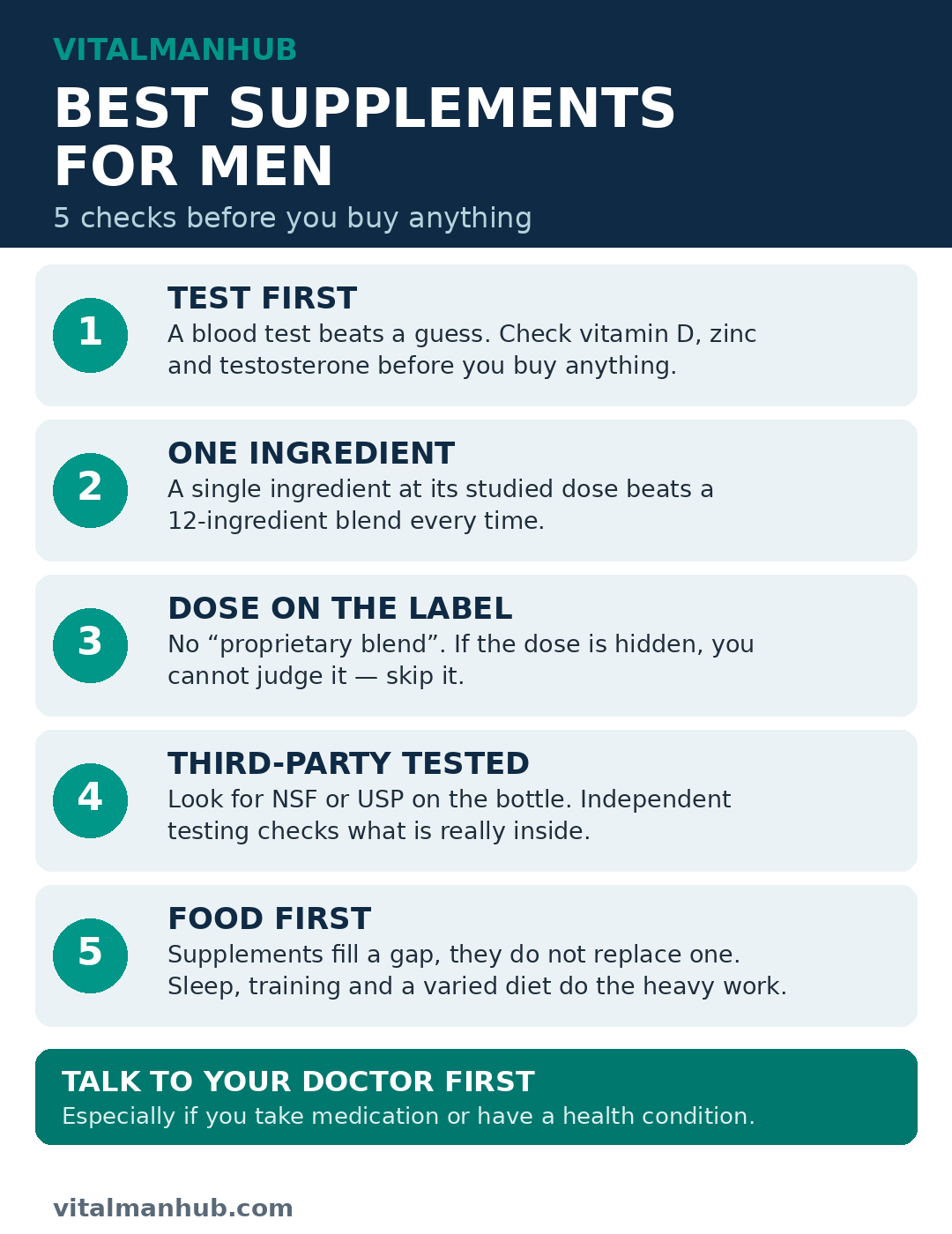
Give it eight to twelve weeks, retest, and stop if nothing changed. If your number has not moved, you have your answer.
The Bottom Line
So what are the best supplements for men? There is no single winner, and there is no bottle that replaces the foundations. The honest shortlist, in order, is: first, test your levels and fix sleep, training, and diet. Then, only if a gap is proven: vitamin D in winter, zinc or magnesium if deficient, omega-3 if you never eat oily fish, creatine if you train, protein powder if food cannot hit your target.
That is a less exciting answer than the adverts offer. A man who tests first, fixes the foundations, and chooses one supplement by its evidence will spend less, risk less, and know — from a blood test, not a feeling — whether anything actually worked.
FAQs
Which of the best supplements for men should I start with?
Start with a blood test, not a bottle. The most common genuine gaps are vitamin D in winter and low protein intake in men who train. If a test shows low vitamin D, a daily 400–1,000 IU supplement is the sensible first step. If your diet already covers protein and your vitamin D is fine, there may be nothing worth starting at all.
Do I need supplements if I eat well?
Probably not. As Cleveland Clinic explains, a healthy adult eating a varied diet usually does not need vitamin supplements. The exceptions are a proven deficiency, a restricted diet such as veganism (vitamin B12), little sun exposure (vitamin D), or a training load that food alone cannot meet (protein, creatine).
Is creatine safe?
Yes, at the studied dose of 3 to 5 grams a day of creatine monohydrate, in healthy adults. Years of trials have not shown kidney or liver damage at recommended doses. The hair-loss claim comes from one small 2009 study that found a rise in DHT and has never been replicated — no trial has measured hair loss itself. If you have kidney disease, ask your doctor first.
Can supplements raise testosterone?
Only modestly, and only in the right situation. Correcting a real zinc or vitamin D deficiency can restore testosterone, and ashwagandha (KSM-66, 600 mg a day) raised it by about 15% in trials of stressed and training men. But no supplement reliably raises testosterone in healthy men with normal levels, and none replaces medical treatment for confirmed low testosterone. The full comparison is in our guide to the best testosterone booster for men.
How do I know if a supplement is safe to buy?
Check four things: the full dose is printed on the label (no proprietary blend), it is a single ingredient at the studied dose, it carries third-party testing such as NSF or USP, and it makes no “guaranteed” or “cure” claims. Buy from established sellers, and tell your doctor — especially if you take medication, because fish oil, magnesium, zinc and ashwagandha can all interact with medicines.
Do the best supplements for men work without exercise?
Mostly no. Creatine and protein only build muscle alongside resistance training — without training, creatine does almost nothing and extra protein is simply burned as energy. Vitamin D, zinc and magnesium correct deficiencies whether or not you train, but their benefits show up as normal levels, not as extra performance. Sleep, training and diet do the heavy work; supplements fill the gaps around them.
Medical disclaimer
This article is for general educational purposes only and is not medical advice. It does not diagnose, treat, cure or prevent any disease. Nutrient needs vary between individuals, and symptoms of deficiency can have many causes. Talk to your doctor or another qualified healthcare professional before changing your diet, starting supplements, or beginning a new exercise programme — especially if you have a medical condition, take medication, or have been told you have low testosterone or a nutrient deficiency. Supplements can interact with medicines and are not a substitute for medical treatment. If you experience chest pain, severe breathlessness or any sudden serious symptom, seek urgent medical care.
For more guides on men’s vitality, visit VitalManHub.
Pingback: Best Supplements for Women: What Is Worth Taking
Pingback: Maca Root for Men: What the Evidence Shows