

Table of Contents
Introduction
Every man who starts ashwagandha asks the same question within a week: is this doing anything yet? The honest answer is that it depends on what you are waiting for — because ashwagandha does not switch on all at once. Sleep and stress are usually the first things to move, energy and recovery come next, and testosterone, if it moves at all, is the last thing on the list. The studies that found any benefit lasted eight to sixteen weeks, and the changes they measured appeared on different schedules inside those weeks.
So how long does ashwagandha take to work? Sleep and stress: two to four weeks. Energy and training recovery: four to eight. Testosterone: eight to sixteen, and only in the right men.
This guide walks through that timeline week by week, explains why the effects arrive in that order, and shows how to tell whether it is working for you. At VitalManHub, the rule is the same: judge a supplement on its trials, not its label.
The Short Answer: A Timeline, Not a Date
If you want the one-line version of how long does ashwagandha take to work, here it is: two to four weeks for sleep and stress, four to eight for energy and recovery, eight to sixteen for testosterone — if it changes at all.
There is no single day when it “starts working” — it does not act like a painkiller. Different effects build at different speeds. The calm and sleep effects come first because they follow cortisol down, and cortisol can fall within weeks. Testosterone comes last because it depends on that cortisol fall plus weeks of better sleep and recovery — a chain of small changes, not one switch.
That is why the honest answer is a timeline, not a date — and why anyone who promises a result by Friday is selling, not informing.
The Timeline at a Glance
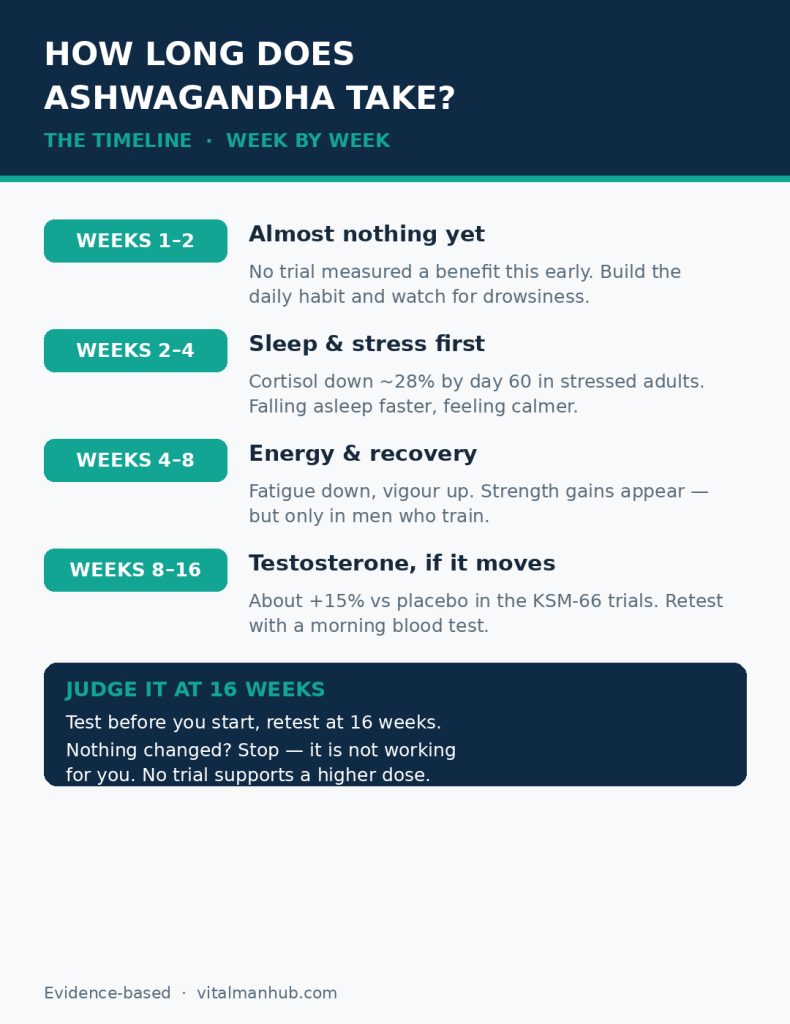
The whole timeline on one page — the windows come from the trials below, not from marketing.
| Timeframe | What usually changes first | What the trials show |
|---|---|---|
| Weeks 1–2 | Almost nothing you can feel | No trial measured a benefit this early |
| Weeks 2–4 | Sleep, stress, calm | Cortisol down ~28% by day 60 in stressed adults; sleep gains in the 2021 meta-analysis |
| Weeks 4–8 | Energy, mood, training recovery | Fatigue down, vigour up; strength gains with training |
| Weeks 8–16 | Testosterone, if it moves | About +15% vs placebo in the KSM-66 trials |
| After 16 weeks | Nothing new expected | No trial ran longer; retest, then decide |
Weeks 1–2: Almost Nothing You Can Feel
The first fortnight is the stage where most men give up — or conclude the bottle is a dud. That is understandable, and it is also too early to judge. No trial measured a benefit in the first two weeks, and there is no reason to expect one — the trials dosed men daily for eight to sixteen weeks.
In these first two weeks you are doing two things: building a steady level of the extract, and learning whether it upsets your stomach or makes you drowsy. A few men feel slightly calmer in the evening, or fall asleep a little faster, but that is a hint, not a result — it could just as easily be a good week.
This is also the stage where most men ask how long does ashwagandha take to work and decide the answer is “never”. Do not decide yet. Keep taking it at the same time each day, note your sleep and stress in one line, and wait for the four-week mark before judging anything.
Weeks 2–4: Sleep and Stress Move First
This is usually the first honest answer to how long does ashwagandha take to work: two to four weeks in, sleep and stress are the first things that shift. In a 2017 trial, 64 adults living with chronic stress took 300 mg of KSM-66 twice a day for sixty days. Their cortisol fell 27.9%, against 7.9% on placebo, and their stress scores fell with it.
Cortisol is the stress hormone: when it stays high for weeks it keeps you wired at night and tired in the day, so a fall is often the first change a man can feel — falling asleep faster, waking less, feeling less on edge.
A 2021 pooling of five small sleep trials found the same pattern: ashwagandha improved sleep quality and shortened the time to fall asleep, by a modest amount, mainly in people with insomnia.
The US National Center for Complementary and Integrative Health agrees — some preparations may help with insomnia and stress. If you notice anything early, it will be here, in weeks two to four: sleep and calm, not testosterone. Our guide to the benefits of ashwagandha for men has the trial evidence behind this summary.
Weeks 4–8: Energy, Mood and Recovery
By now, the question of how long does ashwagandha take to work starts to split: the men who felt something in weeks two to four usually feel more of it now, and the men who felt nothing still feel nothing. That split is expected. Energy and mood do not come from the capsule directly — they follow from better sleep and lower stress, and those take weeks to add up.
In the Lopresti trial of men aged 40 to 70, fatigue fell and vigour improved gradually over sixteen weeks. Strength follows the same logic: in the Wankhede trial, young men on a lifting programme gained more strength and muscle size on ashwagandha than on placebo over eight weeks — but every man in that trial was training, and the supplement most likely helped them recover between sessions, not built muscle on its own.
If you are not training, do not expect a strength change at all. What to look for: steadier energy through the afternoon, less exhaustion after training, a mood that holds up better under pressure. Small, quiet changes — not a jolt.
Weeks 8–16: Testosterone — The Slowest Change
This is the window the trials actually measured, so if you ask how long does ashwagandha take to work for testosterone, this is the only honest answer: eight to sixteen weeks, then a blood test. In 2015, Wankhede and colleagues gave 57 young men on a resistance-training programme 600 mg a day of KSM-66 or a placebo for eight weeks: testosterone rose about 15% on ashwagandha, against about 3% on placebo.
In 2019, Lopresti and colleagues gave 60 overweight men aged 40 to 70 the same daily dose for sixteen weeks: testosterone rose 14.7% against placebo, and DHEA-S — a hormone the body can convert into testosterone — rose about 18%.
A 2023 pooling of four trials with 234 men found the same figure, about 14.7% — but it pools the trials above, so it adds no new men.
Keep the number in proportion: 15% on 400 ng/dL is about 60 ng/dL, and it will not turn a low result into a normal one. A level under 300 ng/dL, checked twice in the morning and paired with symptoms, counts as low — and a low level is a doctor’s job, not a supplement’s. The Cleveland Clinic explains how testing works. If your testosterone has not moved by week sixteen, it is not going to move in week twenty.
Why the Timeline Differs — and What Slows It Down
Two men can take the same capsule at the same dose and get different answers to how long does ashwagandha take to work. The biggest reason is the starting point: ashwagandha helps most when stress, poor sleep, or hard training is holding a man back, because its main route runs through cortisol — the stress hormone brakes testosterone production, and ashwagandha loosens that brake.
In a relaxed, well-slept man with normal testosterone, there is far less brake to release, so there is far less to feel, and the timeline stretches or never arrives.
The second is the foundations: sleeping five hours a night, skipping training, gaining weight — no capsule can outrun that. The third is the product: an unstandardised root powder has no known withanolide content, so no trial result applies to it at all. Age matters too — a low-normal level with a stressful life behind it is the picture that responded best in the trials. Same capsule, different man, different timeline.
Extract, Dose and Timing
Yes — the extracts are different strengths, tested at different doses. KSM-66 is a root-only extract standardised to more than 5% withanolides, and every testosterone trial in this guide used it at 600 mg a day. Shoden is a root-and-leaf extract standardised to 35% withanolide glycosides — far more concentrated — so its dose is only 240 mg a day, and its trial base is smaller.
Sensoril, a root-and-leaf extract at 125 to 250 mg a day, was studied for stress and sleep, not testosterone, so if testosterone is why you are taking it, Sensoril is the wrong tool and its timeline will not match the ones above. Generic root powder has no studied dose and no standardisation, so it has no timeline at all — only a hope.
Match the extract to the trial before you start the clock: a man taking generic powder for eight weeks has not run the same experiment as the men in the trials. If you are still choosing, our guide to the best ashwagandha for men explains how to pick a named extract at the studied dose.
The dose is the trial dose — nothing more, nothing less. KSM-66: 600 mg a day, either 300 mg twice a day with food or 600 mg once.
Shoden: 240 mg a day, and do not take 600 mg of it — it is a far more concentrated extract. Sensoril: 125 to 250 mg a day, for stress and sleep. There is no studied dose for generic root powder, and raising the dose does not speed anything up: no trial supports a higher dose, and a higher dose only raises the chance of side effects.
As for timing, take it in the evening. Drowsiness is a real, reported effect, and the sleep benefit is the one you are most likely to feel first — so an evening dose lines up with the effect you want, and keeps you from driving drowsy. Take it daily, at the same time, for at least eight weeks before judging it, and sixteen before giving up on it. Skipped days do not reset the clock, but a habit of skipping stretches the timeline — the trials dosed men every single day.
How to Tell If It Is Working — and When to Stop
Feelings are a poor measuring tool for a supplement that works slowly, so measure instead. Before you start, take a morning testosterone test — and repeat it if it is low, because one low reading is not a diagnosis.
Write down three numbers: your morning testosterone, your usual time to fall asleep, and a simple stress score out of ten. Retest the blood work at sixteen weeks, at the same time of day, and compare the same three numbers. That comparison is the only way to answer how long does ashwagandha take to work for you personally — everything else is a guess.
Stop and see a doctor promptly for yellowing skin or eyes, dark urine, persistent nausea, or pain in the upper right abdomen: rare liver injury has been reported, usually two to twelve weeks after starting, and it usually settles after stopping — but severe cases have needed a transplant.
Also talk to your doctor first if you take thyroid medicine, sedatives, sleeping pills, or blood-sugar medicine, or have hyperthyroidism — ashwagandha can raise thyroid activity and add to drowsiness. Do not take it in pregnancy.
The Cleveland Clinic’s guide to ashwagandha sets out the cautions in full, and it is worth reading before you buy, not after. If nothing has changed by week sixteen — no better sleep, no calmer days, no movement in the blood test — stop taking it. A supplement that works should show up in a measurement, not just in a hope.

What It Does NOT Do
The label will not give you this list, so here it is. If a product promises any of these, it is selling a story, not a study.
| Claim | What the evidence actually says |
|---|---|
| You will feel it in a few days | No trial supports an effect in days; the earliest measured changes took weeks |
| It will fix low testosterone | At most about +15% in the right men; it cannot turn a low result normal |
| It replaces testosterone therapy | TRT is a medical treatment, prescribed and monitored by a doctor |
| It builds muscle on its own | Strength gains only appeared in men who were training |
| It cures erectile dysfunction | No trial shows this; persistent ED needs a doctor |
| More is faster | No trial supports a higher dose; it only raises side-effect risk |
The Bottom Line
So, how long does ashwagandha take to work? Sleep and stress: two to four weeks. Energy, mood, and recovery: four to eight. Testosterone: eight to sixteen weeks, if it moves at all — and only in the right men, at the studied dose, of a named extract.
That is the whole answer — slower than the label promises, because the label is selling and the trials are measuring. It helps most the men with something to fix — sustained stress, broken sleep, hard training — and least the men with nothing wrong in the first place.
Test first, take a named extract at the trial dose every day, note your sleep and stress, and retest at sixteen weeks. Then you will know, from a measurement and not a feeling, whether it did anything for you.
FAQs
How long does ashwagandha take to work for sleep?
Sleep is usually the first effect, in two to four weeks. A 2021 pooling of five small trials found modest gains in sleep quality and time to fall asleep, mainly in people with insomnia. Take it in the evening, and give it a full month before you judge it — a few good nights in week one is not yet a result.
When will my testosterone change?
If it changes at all, in eight to sixteen weeks — that is how long the trials ran. Test with a morning blood test before you start and again at sixteen weeks, at the same time of day. A rise of about 15% is the most the trials found, and it will not turn a low result into a normal one.
Does the extract I buy change the timeline?
Yes. The testosterone trials used KSM-66 at 600 mg a day; Shoden at 240 mg a day has a smaller trial base; Sensoril was studied for stress and sleep, not testosterone. Generic root powder has no studied dose and no trial behind it, so it has no timeline at all.
Can I feel it working in the first week?
Probably not, and you should not expect to. No trial measured a benefit in the first two weeks. A few men feel slightly calmer in the evening early on, but that is a hint, not a result — wait for the four-week mark before judging anything.
What if nothing has changed after sixteen weeks?
Then it is not working for you — stop taking it. No trial ran longer than sixteen weeks, and no trial supports raising the dose. If your testosterone is low, that is a medical matter: see a doctor rather than trying a different supplement.
Should I take ashwagandha in the morning or evening?
In the evening. Drowsiness is a real effect, and sleep is the benefit you are most likely to feel first, so an evening dose lines up with the effect you want. Take it at the same time every day, with food if it upsets your stomach.
Medical disclaimer
This article is for general educational purposes only and is not medical advice. It does not diagnose, treat, cure or prevent any disease. Testosterone levels vary between individuals and over the day, and symptoms of low testosterone can have many causes.
Talk to your doctor or another qualified healthcare professional before changing your diet, starting supplements, or beginning a new exercise programme — especially if you have a medical condition, take medication, are pregnant or breastfeeding, or have been told you have low testosterone.
Testosterone therapy should only be started after proper testing and diagnosis by a clinician, and never bought online. If you experience chest pain, severe breathlessness, yellowing of the skin or eyes, dark urine, or any sudden serious symptom, seek urgent medical care.
For more guides on men’s vitality, visit VitalManHub.