
Table of Contents
Introduction
Maca root has quietly crossed over from men’s supplement shelves to women’s ones, and the label promises have crossed over with it: more desire, more energy, easier menopause, stronger bones. One root doing the work of four different treatments deserves a careful look. The story of maca root for women is not a scam and it is not a miracle. It is a small, honest signal in one area, a handful of interesting hints in others, and a long list of claims the trials never supported.
This guide goes through maca properly, for women: what the root actually is, what the trials in women found on libido, energy, mood and menopause, what it does to hormones (nothing measurable), how much the trials used, and who should leave it on the shelf. At VitalManHub, every supplement is judged the same way: trials first, marketing last.
What Is Maca Root?
Maca — Lepidium meyenii, also called Peruvian ginseng — is a root vegetable from the high Andes of Peru, grown at 3,500 to 4,500 metres above sea level and eaten there for centuries. It is rich in carbohydrates, fibre, protein, and minerals like iron and calcium.
What sets maca apart from an ordinary root vegetable is a group of compounds found almost nowhere else: macamides and macaenes. These fatty-acid compounds are unique to maca, and researchers think they may affect desire and mood without touching hormones at all. No human trial has confirmed a specific mechanism, so the honest story of maca is “something happens, and we do not fully know why,” not “it balances your hormones.”
Maca comes in three main colours. Yellow maca is the commonest type, and the one most trials used. Red maca is smaller and sweeter, and early research links it more to bone health than to desire. Black maca is rare and pricey, and the little research on it concerns sperm and memory, not desire. Most labels say nothing about colour; when they are silent, the contents are almost certainly yellow.
Maca Root for Women at a Glance
Strongest first, weakest last.
| Area | Evidence strength | What the trials found |
|---|---|---|
| Libido / sexual desire | Best — small but real | Desire up in some small women’s trials; mixed overall |
| Energy | Weak | No trial in women shows an energy or performance gain |
| Mood | Weak | Small mood gains in a few trials, never the main result |
| Menopause / hot flushes | Weak and mixed | One larger trial reported fewer symptoms; reviews call the evidence insufficient |
| Bone health | None in humans | Benefit seen only in animal studies |
| Fertility / pregnancy | No data | No human trials; not recommended in pregnancy |
The pattern is the point. Maca’s one real signal is desire — and desire is not a hormone. Hold on to that distinction — it explains everything that follows.
Libido and Sexual Wellbeing: The Best Evidence — and Its Limits
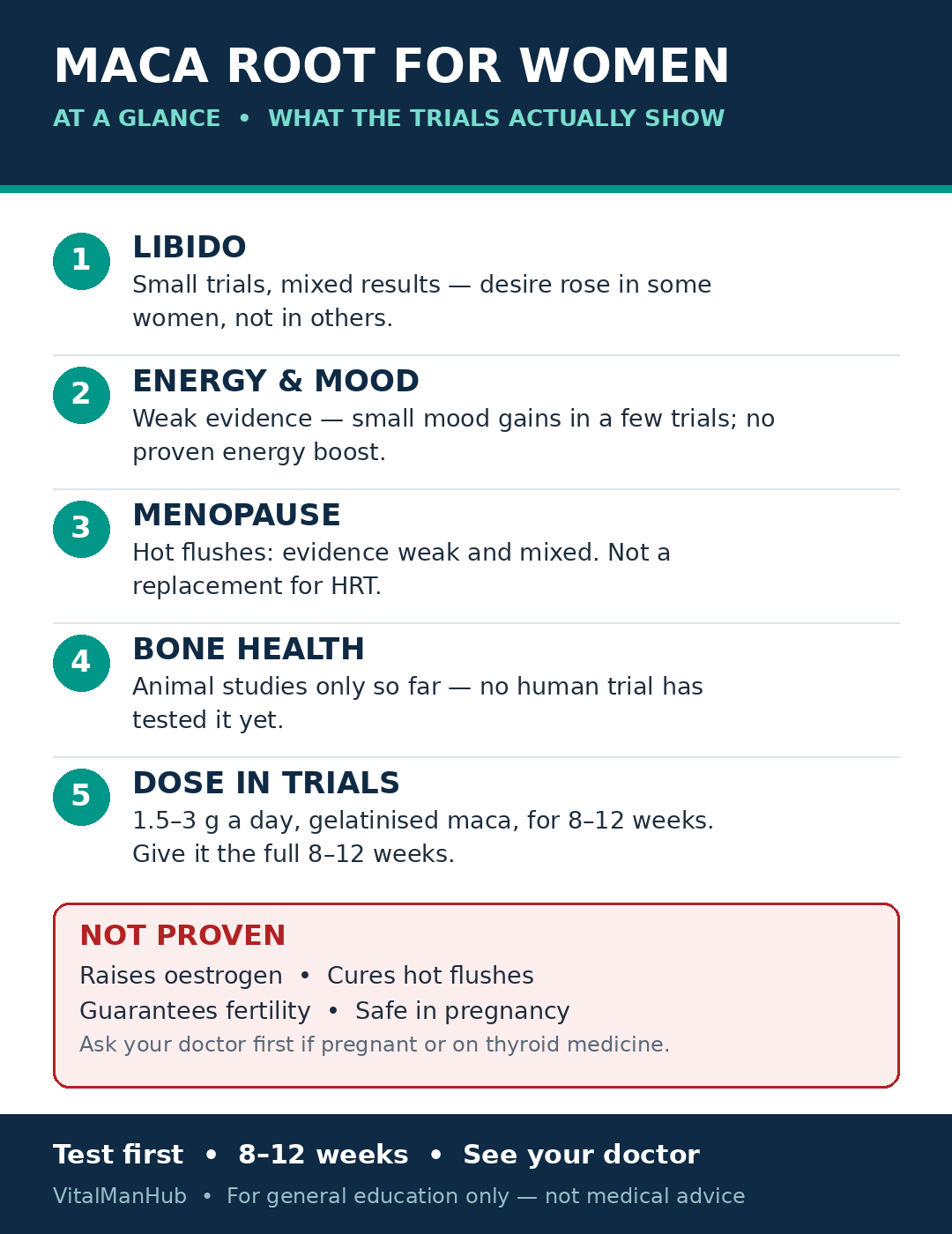
The strongest case for maca in women is libido, and it rests on small trials. The best-known is a pilot study in 45 people, mostly women, whose antidepressants had dulled their sex drive: maca at 3 grams a day for twelve weeks improved sexual function scores, and more people on maca than on placebo reached remission scores — though the numbers were small.
A small crossover trial in 14 postmenopausal women found lower anxiety and depression scores on maca, with no change in oestrogen levels — and the women also reported better sexual function. Fourteen women for six weeks proves very little on its own. And the evidence for maca root for women is thinner than the men’s evidence overall: a 2010 systematic review pooled four randomised trials of maca for sexual function and found the evidence limited — two trials showed a positive effect, and two did not.
One more limit: the trials measured desire, not performance or satisfaction. Wanting sex more and enjoying it more are different things, and maca’s evidence is almost entirely about the first. If the problem is pain during sex, vaginal dryness, or a complete loss of desire after the menopause, maca is the wrong tool — those symptoms deserve a doctor’s appointment. For hormone testing and treatment, the Endocrine Society publishes the professional guidance.
Energy and Mood

The energy claim is where maca root for women marketing runs furthest ahead of its trials. No trial in women shows maca makes a woman stronger, faster, or more enduring — the one small exercise trial always quoted was in eight male cyclists, for two weeks, and a later review graded maca as having no significant effect on physical performance. Borrowing a men’s cycling result to sell maca root for women is not what this guide does.
Mood is similar. A few trials report small improvements in mood scores, usually alongside the desire effect — one small trial in 29 postmenopausal women found lower depression scores and a small fall in diastolic blood pressure after six weeks on 3.3 grams a day, with no change in hormone levels. But mood was never the main thing any trial was designed to measure, and the effects were small. If you are tired because you are stressed and badly slept, maca is a weak answer — sleep, training, and weight are the stronger ones.
Menopause Symptoms: What the Trials Actually Found
Menopause is where maca is sold hardest to women — and where the evidence is weakest. Hot flushes, night sweats, and low mood are real and miserable, and it is understandable to want a natural answer. The trials of maca root for women in menopause are small, and they do not agree with each other.
The most-cited positive result is a trial in 20 perimenopausal women aged 41 to 50 who took 2 grams a day of a specific gelatinised maca preparation for two months: symptom scores improved. It is a small trial of one branded preparation, and it has not been replicated. One small trial that nobody repeats is a hint, not proof.
The pooled evidence is less kind. A 2011 systematic review of maca for menopausal symptoms found the evidence insufficient to support it — too few trials, too small, too mixed. No trial has shown a reliable reduction in hot flushes, and no trial has compared maca against hormone replacement therapy, which is the treatment with the strongest evidence for hot flushes. Menopause guidelines do not recommend maca for hot flushes — the evidence is judged insufficient. The NHS menopause guidance explains the symptoms and HRT options — and it does not list maca among the treatments.
That does not mean maca does nothing in menopause. The small trials that found better mood and less anxiety in postmenopausal women are real results, and feeling calmer and sleeping better can make hot flushes easier to live with. But those are different claims from “treats hot flushes,” and only the first has any support.
Bone Health: A Promise With No Human Trials
Bone health is the claim that sounds most scientific and has the least human evidence behind it. Red maca preserved bone density in rats whose ovaries had been removed — the standard animal model for postmenopausal bone loss — and that result is quoted on supplement labels as if it were a human trial. It is not: no human trial of maca root for women has tested bone density, bone loss, or fracture risk.
That matters because bone loss after the menopause is fast — up to a fifth of bone density in the five to seven years after the final period — and it is also well understood. Calcium, vitamin D, strength training, and weight-bearing exercise all have human evidence behind them, and HRT protects bone when it is prescribed. A powder with only rat data should never stand in for any of those.
Fertility, Pregnancy and Breastfeeding: Doctor First
Fertility is the area where maca root for women is most often oversold to women, and the evidence is not mixed — it is absent. No human trial has tested whether maca helps a woman conceive, and no trial has measured pregnancy rates. Animal studies found no obvious harm at food-level doses, but that is not safety data for a pregnant woman.
There is no safety data for maca root for women in pregnancy or breastfeeding: do not take it while pregnant, trying to conceive, or breastfeeding unless your doctor says otherwise. A woman with a fertility concern should get a proper medical work-up — hormone tests, ovulation checks, and a partner’s semen analysis — rather than relying on a supplement with no fertility trials in women.
Dose and Forms: What the Trials Actually Used
If you decide to try maca root for women anyway, use the dose the trials used — not the dose on the loudest label. The trials that showed anything used 1.5 to 3 grams a day for eight to twelve weeks, and the desire effect in the best men’s trial did not appear until week eight. The women’s trials used the same range and ran for six to twelve weeks — one used 3.5 grams a day. Any product promising results in a week is promising something no trial has shown. Take it for the full twelve weeks, then judge it honestly: if nothing has changed, stop.
The form matters too. Most trials used gelatinised maca — heated under pressure to break down its starch. Raw maca is tougher on the stomach, because the raw root is about 60 to 75 percent starch. Capsules and powder are the same thing in different packaging — powder is cheaper per gram, capsules are easier to dose.
Our guide to the best supplements for women puts maca in context: the label should state the colour and the form, the dose should match the trial dose, and the product should be third-party tested. A “proprietary blend” that hides the amount of maca inside is not worth your money.
Side Effects and Safety
Maca is generally well tolerated. The largest safety trial — Gonzales-Arimborgo and colleagues, 2016 — gave 175 adults 3 grams a day of black or red maca extract for twelve weeks and found no serious adverse effects, and no changes in blood pressure or liver or kidney markers. Long-term safety is not established, and a few women in trials reported headaches, irritability, or trouble sleeping. The Cleveland Clinic’s guide to maca root says the same: short-term use at trial doses looks safe for most healthy adults. For maca root for women, the common side effects are mild: stomach upset and bloating, usually from raw maca, eased by switching to the gelatinised form.
Who Should Avoid It
Some women should skip maca root for women entirely, or not start it without a doctor’s advice.
First, anyone who is pregnant, trying to conceive, or breastfeeding. There is no safety data here, and “natural” does not mean safe in pregnancy — the NHS notes that some supplements are actively unsafe in pregnancy.
Second, anyone with a thyroid condition. Maca is a brassica, and like other brassicas it contains glucosinolates — compounds that can interfere with iodine uptake in large amounts. No trial has shown thyroid harm, but women with hypothyroidism or on thyroid medicine should ask their doctor first.
Third, anyone with a hormone-sensitive condition — including endometriosis, fibroids, or a history of hormone-sensitive cancer such as breast cancer — should be cautious. Maca does not raise oestrogen in the trials that measured it, but laboratory work has found oestrogen-like activity in breast-cancer cells, so any woman with a hormone-sensitive condition should check with her clinician before taking it.
Finally, if you take medication for blood pressure, blood sugar, or mood, or you have liver or kidney disease, talk to your doctor first. No known interactions is not the same as no interactions — it means nobody has looked very hard.
What Maca Does NOT Do
You will not find this list on a label for maca root for women, so here it is.
| Claim | What the evidence actually says |
|---|---|
| Raises oestrogen | No trial found a rise; hormones were unchanged in the trials that measured them |
| Cures hot flushes | No trial shows a reliable reduction; reviews call the evidence insufficient |
| Guarantees fertility | No human trials in women; no pregnancy data at all |
| Strengthens bones | Benefit seen only in rats; no human trial has tested bone density |
| Boosts energy | No trial in women shows an energy or performance gain |
| Works in a week | The desire effect took eight weeks to appear in the best trial |
| Replaces HRT | HRT is a medical treatment; maca cannot replace it for hot flushes or bone protection |
| Is safe in pregnancy | No safety data; not recommended without a doctor’s advice |
Any product that claims otherwise is selling a story, not a study.
The Bottom Line
So what is maca root for women, honestly? A Peruvian food with one real, modest effect: it may lift sexual desire a little, after eight to twelve weeks, in some women — without changing oestrogen at all. That is the whole case for maca. Energy, mood, and menopause rest on weaker, mixed evidence, bone health rests on animal studies only, and fertility rests on none.
The pattern is the point. Maca helps a woman whose problem is desire, not hormones. The menopause is a medical transition, not a deficiency, and a root powder is not a treatment for it — test first, fix sleep, training, and weight, and if you want to try it, take 1.5 to 3 grams a day of gelatinised maca for twelve weeks. Men reading this can compare it with our guide to maca root for men, where the same root was tested in men — with the same honest answer: desire, maybe; hormones, no.
FAQs
Does maca root help with libido in women?
Modestly, and not for everyone. A small pilot trial in 45 people, mostly women, whose antidepressants had dulled their sex drive found maca at 3 grams a day improved sexual function, and a small trial in postmenopausal women found better sexual function scores too. But a systematic review of four trials found two positive and two negative, and called the evidence too limited for firm conclusions. Expect a small effect after eight weeks, or none at all.
Does maca root help with menopause hot flushes?
There is no reliable evidence that it does. One small trial in 20 perimenopausal women reported fewer menopausal symptoms on a specific gelatinised preparation, but it has not been replicated, and a systematic review found the evidence insufficient. No trial has shown a reliable reduction in hot flushes, and maca has never been compared with HRT. If hot flushes are ruining your sleep, talk to your doctor about proven options.
How much maca root should women take?
The trials used 1.5 to 3 grams a day of gelatinised maca for eight to twelve weeks. Start at the lower end, take it daily, and give it the full twelve weeks before judging it. Gelatinised maca is easier to digest than raw maca, and it is the form the trials actually tested.
Is maca root safe for women?
Short-term use at trial doses looks safe for most healthy women — a 175-person trial at 3 grams a day for twelve weeks found no serious adverse effects. Mild stomach upset and bloating are the common complaints, usually from raw maca. Women who are pregnant, breastfeeding, or trying to conceive should not take it without a doctor’s advice, and women with thyroid conditions or hormone-sensitive conditions should talk to a doctor first.
Can I take maca root while pregnant or breastfeeding?
Do not take it without a doctor’s advice. There is no safety data for maca in pregnancy or breastfeeding in humans — animal studies are not a substitute. If you are trying to conceive, the proven steps are folic acid, a healthy weight, and a medical work-up if conception is taking time, not a supplement with no fertility trials in women.
Gelatinised or raw maca — which is better?
Gelatinised. It has been heated under pressure to break down the root’s starch, so it is easier to digest and less likely to cause stomach upset. It is also the form used in most of the trials, so the evidence actually covers it. Raw maca is cheaper but harder on the stomach and less studied.
Medical disclaimer
This article is for general educational purposes only and is not medical advice. It does not diagnose, treat, cure or prevent any disease.
Hormone levels and menopause symptoms vary between individuals, and symptoms such as low desire, hot flushes, or irregular periods can have many causes. Talk to your doctor or another qualified healthcare professional before changing your diet, starting supplements, or beginning a new exercise programme — especially if you are pregnant, breastfeeding, trying to conceive, have a medical condition such as a thyroid or hormone-sensitive condition, or take medication. Supplements can interact with medicines and are not a substitute for medical treatment. If you experience chest pain, severe breathlessness, heavy or unusual bleeding, or any sudden serious symptom, seek urgent medical care.
For more guides on women’s health, visit VitalManHub.