

Table of Contents
Introduction
Walk into any supplement shop and the bottles all make the same promises: more energy, stronger hair, better sleep, healthier skin. It is easy to believe the best supplements for women are the ones with the longest list of claims — and just as easy to waste money on them.
This guide does not rank brands. For each supplement it looks at who it helps, what the trials found, the dose studied, and the risks. At VitalManHub, the approach is the same as in every guide here — check your levels first, sort out food, sleep, and movement, and only then judge a supplement on its evidence. Most healthy women need very few supplements — only for a proven deficiency, a diet gap, or a life stage food alone cannot cover.
Who Actually Needs Supplements? Test First
Supplements exist to fill a gap — and for most women, most of the time, there is none. The NHS puts it plainly: most people should get all the nutrients they need from a varied diet, and only some people need extra supplements.
So who does need them? That is the first question behind the best supplements for women — not which bottle to buy, but whether you have a gap worth filling:
- Heavy periods — monthly blood loss is the most common reason women run low on iron.
- A proven deficiency — a blood test showing low iron, vitamin D, or B12 is a reason to supplement. A feeling is not.
- Little sun — indoor work through winter, or covering most of your skin outdoors, makes vitamin D the most likely genuine gap.
- A vegan diet — animal foods are the only natural source of vitamin B12, so a B12 supplement is essential.
- Pregnancy, breastfeeding, or trying to conceive — folic acid and vitamin D are recommended here; see the pregnancy section below.
- Over 50 — after the menopause, bone loss speeds up, and calcium plus vitamin D matter more than they did at 30.
For everyone else, diet, sleep, movement, and stress management do the heavy work. Men reading this will find their own version in our guide to the best supplements for men, covering the men’s doses and the training supplements creatine and protein.
The Shortlist: The Best Supplements for Women at a Glance
The table below is the short answer to the best supplements for women question — each row is explained below, limits included.
| Supplement | Who it helps | Studied dose | Evidence |
|---|---|---|---|
| Iron | Women with heavy periods or low ferritin | 18 mg/day (food first); supplement only if tested low | Strong when deficient; no gain if levels are normal |
| Calcium | Women over 50, low dairy intake | 1,000 mg/day (1,200 mg/day at 51+) | Protects bones with vitamin D; modest alone |
| Vitamin D | Little sun, winter, darker skin | 600 IU/day (15 mcg); 800 IU/day at 71+ | Strong for bones; modest for immunity |
| Folate / folic acid | Women who could become pregnant | 400 mcg/day folic acid | Strong for preventing neural tube defects |
| Omega-3 (EPA/DHA) | Women who rarely eat oily fish | 250–500 mg/day EPA+DHA | Heart and triglycerides; small effects |
| Magnesium | Women low on leafy greens, nuts, whole grains | 310–320 mg/day | Helps muscle and sleep; evidence modest |
| Vitamin B12 | Vegans, older women, long-term PPI/metformin use | 2.4 mcg/day | Essential when deficient; no gain if levels are normal |
Iron: The Period Gap
Iron is the first supplement on any honest list of the best supplements for women, because periods make women’s iron needs different from men’s. Women aged 19 to 50 need about 18 mg a day — more than double the 8 mg men need — and heavy periods can push that higher still. Low iron is the most common nutrient deficiency in women worldwide, usually showing up as tiredness and breathlessness on stairs.
Check first: ferritin measures iron stores, and a full blood count shows whether it has become anaemia. If ferritin is low, iron works — but slowly, over two to three months, at the dose your doctor advises. Do not supplement blindly: too much iron causes constipation and stomach pain, and long-term excess can damage liver and heart. Take iron apart from calcium, with vitamin C — orange juice with a meal helps — while tea and coffee with meals block absorption.
Calcium and Vitamin D: Bones After the Menopause
Calcium and vitamin D belong together, because vitamin D is what lets your body absorb calcium. Women need about 1,000 mg of calcium a day from 19 to 50, rising to 1,200 mg from 51 — the rise is down to the menopause. When oestrogen falls, bone loss speeds up — up to a fifth of bone density in the five to seven years after the menopause.
Food comes first: dairy, fortified plant milks, leafy greens, and tinned sardines with their soft bones. A supplement earns its place among the best supplements for women after 50 only when food falls short — and take no more than 500 to 600 mg in one dose, as the body cannot absorb more at once. Very high intakes are linked to kidney stones.
For vitamin D, the intake is 600 IU (15 micrograms) a day to 70 and 800 IU from 71; the UK advises 10 micrograms daily from October to March. Check your level with a 25(OH)D test, and do not exceed 4,000 IU a day without a doctor’s advice — very high doses can raise blood calcium to dangerous levels.

Folate: Before and During Pregnancy
Folate is the one supplement where timing matters more than dose. Every woman who could become pregnant should take 400 micrograms of folic acid a day, from three months before conception through the first twelve weeks of pregnancy. In that window it cuts the chance of neural tube defects such as spina bifida; food alone rarely supplies enough.
The NHS pregnancy vitamins guidance gives the same numbers: 400 micrograms of folic acid and 10 micrograms of vitamin D a day in pregnancy. Some women need 5 mg a day — with diabetes, epilepsy medicine, or a previous pregnancy affected by a neural tube defect — but that dose is GP-prescribed.
Two cautions: high folic acid can mask a B12 deficiency, so check B12 too; and never take vitamin A, retinol, or cod liver oil in pregnancy — too much can harm your baby’s development. Pregnant, breastfeeding, or trying to conceive? Talk to your doctor or midwife before starting any supplement.
Omega-3: Fish on the Plate Comes First
With omega-3, food and supplements agree: two weekly servings of oily fish — salmon, sardines, mackerel — supply roughly 250 to 500 mg of EPA and DHA a day.
If oily fish never appears on your plate, a capsule is a fair stand-in. Keep expectations modest: omega-3s bring triglycerides down, and at prescription strength of about 4 grams a day the drop is large, around 20 to 30% — but at the dose in an ordinary supplement, the effect on heart risk in healthy women is small.
In pregnancy, DHA also helps the baby’s brain and eyes develop, which is another reason oily fish is recommended — but skip fish high in mercury, such as shark, swordfish, and marlin, and keep tuna to no more than two steaks a week. Fish oil thins the blood a little — mention it to your doctor if you take a blood thinner. Algae oil offers the same EPA and DHA for vegetarians.
Magnesium and Vitamin B12: The Quiet Gaps
Magnesium is the quiet gap in the modern diet. Women need 310 to 320 mg a day, and many do not get that from food — the richest sources are leafy greens, nuts, seeds, and whole grains, which are exactly the foods most people eat least. It powers hundreds of processes, from muscle function to energy production, and topping it up helps when levels are genuinely low. For sleep, small trials point to slightly better sleep quality — a modest gain, not a transformation. Pick glycinate or citrate over oxide, which absorbs poorly, and stay at or below 350 mg a day from supplements.
Vitamin B12 is a different kind of gap: not a diet shortfall but an absorption problem. Women need only 2.4 micrograms a day, and animal foods supply it easily — but vegans get almost none, and older women absorb less as stomach acid falls. Stomach-acid medicines (PPIs) and the diabetes drug metformin also lower absorption. Deficiency brings tiredness and anaemia first, then nerve damage — tingling and numbness — that can turn permanent if missed. A B12 blood test settles it, and a supplement or fortified food is essential on a vegan diet.
Supplements at Each Life Stage
Women’s supplement needs change more across a lifetime than men’s do, because periods, pregnancy, and the menopause each move the goalposts.
In your 20s and 30s, the main gaps are iron and folate — heavy periods drain iron, and folic acid matters from the moment pregnancy becomes possible. Vitamin D in winter and B12 on a vegan diet complete the shortlist.
In pregnancy and breastfeeding, the rules tighten. Folic acid 400 micrograms and vitamin D 10 micrograms a day are the routine recommendations, iron only if a blood test says so, and vitamin A supplements and cod liver oil are out. Your doctor or midwife should know about every supplement you take, including herbal ones — “natural” does not mean safe in pregnancy.
Around and after the menopause, the priority shifts to bones. Calcium and vitamin D become the main pair, with strength training and weight-bearing exercise, which do more for bone density than any pill. Hormone replacement therapy (HRT) is a medical decision made with a doctor — not a supplement, and no supplement replaces it. Soy isoflavones are sold for hot flushes, but trials are mixed and any effect is small.
What to Avoid
Some products sold as the best supplements for women are not merely ineffective; they are risky. Most products sold as the best supplements for women fail at least one of these checks, and the worst fail all of them.
Proprietary blends. When a label hides its amounts behind a “proprietary blend,” there is no way to tell whether it holds the studied dose or a token sprinkle for decoration. No dose, no deal.
Mega-doses. More is not better; past the safe upper limit, it is worse. Vitamin A above 10,000 IU a day can damage the liver — and is dangerous in pregnancy. Vitamin B6 above 100 mg a day can cause nerve damage. Vitamin D above 4,000 IU a day can raise blood calcium. When a product brags about a dose far above the recommended intake, treat that as a warning, not a feature.
Hidden drugs. Supplements are not approved for safety or effectiveness before sale in the US or the UK, and regulators have repeatedly found “weight loss,” “detox,” and “female vitality” products spiked with undeclared drugs — laxatives, diuretics, and stimulants. A product that secretly contains a drug is not a supplement; it is medicine with no label and no stated risks.
Cure and guarantee claims. Walk away from anything that promises “guaranteed results,” “hormone balance in 30 days,” or a “cure.” The Endocrine Society publishes guidance on hormone testing and treatment, and no reputable guidance supports a supplement as a cure for anything.
Collagen and biotin hype. Collagen powders and biotin gummies are sold hard for hair, skin, and nails, but the evidence is thin — a few small, short trials, often maker-funded. Biotin can skew laboratory tests, including thyroid tests and the troponin test used to diagnose a heart attack. Tell your doctor and your lab if you take it.
St John’s wort. Sold for low mood, this herb interacts with a long list of medicines — including the contraceptive pill, which it can make less effective, plus antidepressants, blood thinners, and some cancer drugs. Never combine it with prescription medicines without a doctor’s advice.
How to Choose: Your Checklist
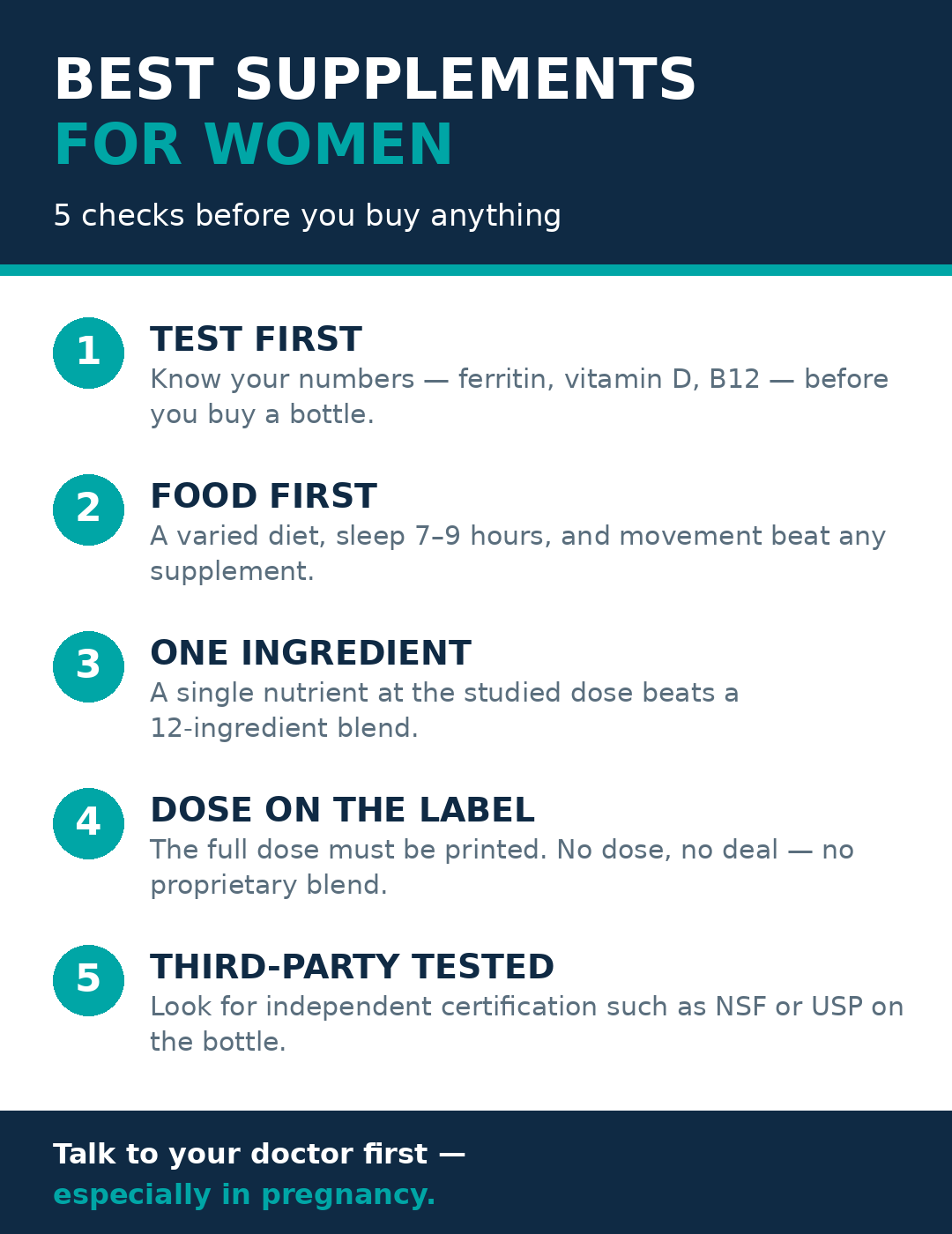
If you want the best supplements for women on one page, this is it. Run every product through this checklist before you buy.
| Check | What to look for |
|---|---|
| Test first | A blood test for ferritin, vitamin D, and B12 — know your number before you buy |
| Food first | A varied diet, sleep 7–9 hours, strength training — supplements add to these, never replace them |
| One ingredient | A single ingredient at the studied dose beats a twelve-ingredient blend |
| Dose on the label | The full dose printed, matching the trial dose — no proprietary blend |
| Third-party tested | Independent certification (e.g. NSF, USP) on the bottle |
| Honest claims | No “guaranteed,” “cure,” or “hormone balance” promises anywhere on the label |
| Doctor first | Tell your doctor, especially if you are pregnant, breastfeeding, or take medication — including the pill |
| Retest in 8–12 weeks | A supplement that works should show up in a blood test, not just in a feeling |
Give it eight to twelve weeks, retest, and stop if nothing changed — if your number has not moved, you have your answer.
The Bottom Line
So what are the best supplements for women? No single bottle wins, and none replaces the foundations. Test your levels and fix sleep, diet, and movement first. Then, only if a gap is proven — iron for heavy periods or low ferritin, calcium plus vitamin D after 50, folic acid if you could become pregnant, omega-3 if you never eat oily fish, magnesium or B12 if you are low.
That is less exciting than the adverts. A woman who tests first, fixes the foundations, and picks one supplement by its evidence spends less, risks less, and knows — from a blood test, not a feeling — whether it worked.
FAQs
Which of the best supplements for women should I start with?
Start with a blood test, not a bottle. The most common genuine gaps are iron in women with heavy periods and vitamin D in winter. If a test shows low ferritin, iron is the sensible first step; if your vitamin D is low, a daily 400–1,000 IU supplement is. If you could become pregnant, folic acid 400 micrograms a day comes first, whatever the blood test says. If your diet already covers these and your levels are fine, there may be nothing worth starting at all.
Do I need supplements if I eat well?
Probably not. As the NHS explains, most people should get all the nutrients they need from a varied diet. The exceptions are a proven deficiency, a restricted diet such as veganism (vitamin B12), heavy periods (iron), little sun exposure (vitamin D), pregnancy (folic acid and vitamin D), or being over 50 (calcium and vitamin D for bones).
Can I take supplements while pregnant?
Some, yes — and some, definitely not. Folic acid 400 micrograms a day and vitamin D 10 micrograms a day are recommended in pregnancy, and iron only if your doctor prescribes it after a blood test. Do not take vitamin A or retinol supplements, or cod liver oil, while pregnant. Always talk to your doctor or midwife first — see the NHS pregnancy vitamins guidance for the full list.
Do collagen and biotin supplements work for hair and nails?
The evidence is thin: a few small, short trials, often funded by the companies selling the products. Biotin has a real downside — it can interfere with laboratory tests, including thyroid tests and the troponin test used to diagnose a heart attack. If your hair is thinning or your nails are breaking, a blood test for iron, B12, and thyroid function is a better first step than a gummy.
Are supplements safe with the contraceptive pill or HRT?
Most single-nutrient supplements are, but herbal products are the risk. St John’s wort can make the contraceptive pill less effective, and it interacts with many other medicines. Calcium can also reduce the absorption of thyroid medicine, so take them at least four hours apart. Tell your doctor about every supplement you take — including herbal ones — so they can check for interactions.
How do I know if a supplement is safe to buy?
Look for four things before you buy: the full dose printed on the label (no proprietary blend), one ingredient at the studied dose, third-party testing such as NSF or USP, and no “guaranteed” or “cure” claims anywhere on it. Buy from established sellers, and tell your doctor — especially if you are pregnant or breastfeeding, or take medication, because iron, calcium, magnesium, and St John’s wort can all interact with medicines.
Medical disclaimer
This article is for general educational purposes only and is not medical advice. It does not diagnose, treat, cure or prevent any disease. Nutrient needs vary between individuals, and symptoms of deficiency can have many causes. Talk to your doctor or another qualified healthcare professional before changing your diet, starting supplements, or beginning a new exercise programme — especially if you are pregnant, breastfeeding, trying to conceive, have a medical condition, or take medication, including the contraceptive pill. Supplements can interact with medicines and are not a substitute for medical treatment. If you experience chest pain, severe breathlessness or any sudden serious symptom, seek urgent medical care.
For more guides on women’s health, visit VitalManHub.
Pingback: Maca Root for Women: What the Evidence Shows