
Table of Contents
Introduction
Every bottle of ashwagandha looks the same on the shelf — a brown root, a calm man on the label, and a promise about stress, sleep, and testosterone. The bottles are not the same: some hold the exact extract used in the published trials, at the exact dose; others hold unstandardised root powder no trial has tested, and the front of the bottle will not tell you which.
The best ashwagandha for men is not a brand. It is a specific extract, at a specific dose, bought for a specific reason — because ashwagandha only helps some men. This guide explains what ashwagandha is, how KSM-66, Shoden, and generic root powder differ, what the trials found, and the five checks that separate a product worth buying from one worth leaving on the shelf. At VitalManHub, the rule is the same: test first, fix the foundations, and judge a supplement on its evidence.
What Ashwagandha Actually Is
Ashwagandha (Withania somnifera), also called Indian ginseng or winter cherry, is a shrub whose root has been used in Ayurvedic medicine for thousands of years. It is called an adaptogen, but what matters for a buyer is simpler: the root contains compounds called withanolides, and how many are in a capsule is what separates a studied product from a guessing game. A root has no fixed withanolide content — it varies with soil, season, and plant part — so a standardised extract concentrates the root and tests every batch. That is why the trials never tested “ashwagandha” in general: they tested named extracts, and the name on the label is the first check.
The best ashwagandha for men, on the current evidence, is a standardised root extract taken at the dose the trials used.
KSM-66 vs Shoden vs Generic Root Powder
Three products sit on the shelf under the same name, and judging the best ashwagandha for men means telling them apart.
KSM-66 is a full-spectrum root-only extract, standardised to more than 5% withanolides, with the largest trial base — every testosterone trial in this guide used it, at 600 mg a day. When a trial says ashwagandha raised testosterone by about 15%, it almost always means KSM-66 at 600 mg a day.
Shoden is a newer root-and-leaf extract, standardised to 35% withanolide glycosides — far more concentrated, so its dose is only 240 mg a day. Its trials point the same way as KSM-66’s, including testosterone and DHEA-S rises in men aged 40 to 70, but the trial base is smaller: a credible alternative, not a proven upgrade.
Generic root powder is simply dried root, ground up, with no standardisation — one batch may hold far more withanolides than another, and no trial has tested it at a known dose. It is also the cheapest option, which is why it is everywhere — but tradition is not a clinical trial, and an unstandardised powder cannot be matched to any result in this guide.
| Extract | What it is | Studied dose | Trial base | Best for |
|---|---|---|---|---|
| KSM-66 | Root-only extract, >5% withanolides | 600 mg/day | Largest — the testosterone trials below | The default choice on current evidence |
| Shoden | Root + leaf extract, 35% withanolide glycosides | 240 mg/day | Smaller — a few trials in men 40–70 | A credible alternative at a lower dose |
| Sensoril | Root + leaf extract, ≥10% withanolides | 125–250 mg/day | Stress and sleep trials; little testosterone data | Stress and sleep, not testosterone |
| Generic root powder | Dried root, ground — not standardised | No studied dose | None at a known dose | No trial result applies to it |
Sensoril earns a row because you will see it on shelves: a genuine named extract, but its trials focused on stress, sleep, and cognition — not testosterone — so if testosterone is why you are buying, it is the wrong tool.
The Trials in Detail: What the Numbers Really Say
Ashwagandha has the strongest testosterone evidence of any herbal ingredient — modest, from a small trial base. That is why the best ashwagandha for men is a question of evidence, not marketing. Our comparison of the best testosterone booster for men puts ashwagandha first.
Wankhede et al., 2015. Fifty-seven young men on a resistance-training programme took 600 mg a day of KSM-66 or placebo for eight weeks: testosterone rose about 15% versus about 3% on placebo, with bigger strength and muscle gains. Note who was studied: young, healthy, training men — not men with diagnosed low testosterone. It shows ashwagandha adds something on top of training, not that it fixes low testosterone.
Lopresti et al., 2019. Sixty overweight men aged 40 to 70 took 600 mg a day of KSM-66 or placebo for sixteen weeks. Testosterone rose 14.7% versus placebo, DHEA-S about 18%, fatigue fell and vigour improved, while oestradiol, LH, and FSH did not change.
The 2023 meta-analysis pooled four trials with 234 men and found the same figure: about a 14.7% rise versus placebo. That sounds like independent confirmation, but it is not — it pools the trials above, the same men counted again. It strengthens the case without adding a single new man, and no trial ran longer than sixteen weeks.
Keep the numbers in proportion: 15% on 400 ng/dL is about 60 ng/dL, and it will not turn a low result into a normal one — if your testosterone is 250 ng/dL, ashwagandha will not make it 400.
How It Works: Cortisol, Stress and Testosterone
The most likely explanation runs through cortisol. When stress stays high for weeks, cortisol stays high with it — and cortisol brakes testosterone production, partly by suppressing the brain signals that tell the testes to work. A stressed, badly slept, hard-training man is often running with that brake half on.
Ashwagandha loosens the brake: in a 2017 trial of 64 chronically stressed adults, 300 mg of KSM-66 twice a day for sixty days cut cortisol by 27.9% against 7.9% on placebo, and stress scores fell with it. That is why the biggest testosterone rises show up in stressed men, poor sleepers, and men in hard training — in a relaxed man with normal testosterone, there is far less brake to release.
So it is no shortcut around the foundations: sleep, training, and weight loss lower cortisol too, more reliably than any capsule. Ashwagandha is an addition to those levers, not a replacement.
Sleep and Strength: What Else the Trials Found
Two other findings matter when judging the best ashwagandha for men: they are why many men stay on it even when their testosterone barely moves. A 2021 meta-analysis of five small sleep trials found ashwagandha improved sleep quality and shortened the time to fall asleep, mainly in insomnia, and by a modest amount. The US National Center for Complementary and Integrative Health agrees: some preparations may help insomnia and stress. Take it in the evening: drowsiness is a real effect.
On strength, the Wankhede trial is the main evidence: its ashwagandha group gained more strength and muscle size than placebo over eight weeks of identical training. Read it as a training result, not a muscle drug — the men were all training, and ashwagandha most likely helped recovery between sessions.
Dose and Duration: 600 mg a Day, for 8–16 Weeks
The dose is where the best ashwagandha for men is decided — the extracts are different strengths:
- KSM-66: 600 mg a day — 300 mg twice a day with food, or 600 mg once — the dose in every testosterone trial above.
- Shoden: 240 mg a day. Do not take 600 mg of Shoden — it is a far more concentrated extract.
- Sensoril: 125 to 250 mg a day, for stress and sleep.
- Generic root powder: there is no studied dose. Traditional use is roughly a teaspoon or two a day, but with no standardisation, that tells you nothing about how many withanolides you are getting.
Take it daily for at least eight weeks, then retest with a morning testosterone test at the same time of day. If your number has not moved after sixteen weeks, it is not working for you; do not raise the dose, as no trial supports a higher one.
Before you start, test first: testosterone below 300 ng/dL, confirmed twice, with symptoms, is low — the Cleveland Clinic explains the testing. A single low reading is not a diagnosis.
Who It Helps Most — and Who Should Skip It
The best ashwagandha for men is wasted on a man with nothing to fix. It helps most the men whose testosterone is held down by stress and poor recovery — sustained pressure, bad sleep, hard training, a low-normal level with a stressful life behind it. The over-40 men in the Lopresti trial fit that picture, and they saw the clearest rise.
It helps least the men without that problem — healthy, low-stress men with normal testosterone should expect little or nothing. Age alone is not a reason — testosterone falls about 1% a year from around 30 to 40, as the NHS explains, but a slow, normal decline is not a deficiency.
Some men should skip it entirely — that is the next section. But first, the foundations: if you have not yet sorted sleep, training, and weight, start with our guide on how to increase testosterone naturally.
Side Effects and Interactions
Ashwagandha is usually well tolerated at studied doses, but “natural” is not “safe for everyone” — the Cleveland Clinic’s guide to ashwagandha sets out the cautions.
Common side effects are mild: drowsiness, stomach upset, diarrhoea, and nausea. Plan around drowsiness — take it in the evening, and do not drive until you know how it affects you.
Liver injury is rare but real: case reports describe it appearing two to twelve weeks after starting, usually settling within months of stopping — but severe cases needing a transplant have been reported. Stop and see a doctor promptly for yellowing skin or eyes, dark urine, persistent nausea, or pain in the upper right abdomen.
Thyroid. Ashwagandha can increase thyroid activity — do not take it with hyperthyroidism or borderline thyroid function, and tell your doctor if you take thyroid medicine.
Sedatives, alcohol, and blood-sugar medicines. Ashwagandha adds to drowsiness — do not combine it with sleeping pills, anxiety medicines, or alcohol without a doctor’s advice. It may also lower blood sugar, so if you take diabetes medicine, monitor your levels and tell your doctor.
Pregnancy and breastfeeding. Do not take it in pregnancy — it may contribute to uterine contractions — or while breastfeeding, where safety data is lacking.
Tell your doctor if you take blood-pressure medicine or immunosuppressants, have an autoimmune condition, or have liver, thyroid, or prostate problems. Denmark has banned ashwagandha outright over safety concerns — a reminder that regulators do not all agree it is low-risk.
How to Choose: Your Checklist
If you want the best ashwagandha for men on one page, this is it. Use it to find the best ashwagandha for men for you.
| Check | What to look for |
|---|---|
| Test first | A morning testosterone test, repeated if low — know your number before you buy |
| Named extract | KSM-66 (600 mg/day) or Shoden (240 mg/day) — not generic root powder |
| Dose on the label | The full dose printed, matching the trial dose — no proprietary blend |
| Third-party tested | Independent certification (e.g. NSF, USP) on the bottle |
| One ingredient | A single extract at the studied dose beats a twelve-ingredient blend |
| Honest claims | No “guaranteed,” “cure,” or “permanent” promises anywhere on the label |
| Doctor first | Tell your doctor, especially with sedatives, blood-sugar or thyroid medicine |
| Retest in 8–16 weeks | A supplement that works should show up in a blood test, not just in a feeling |
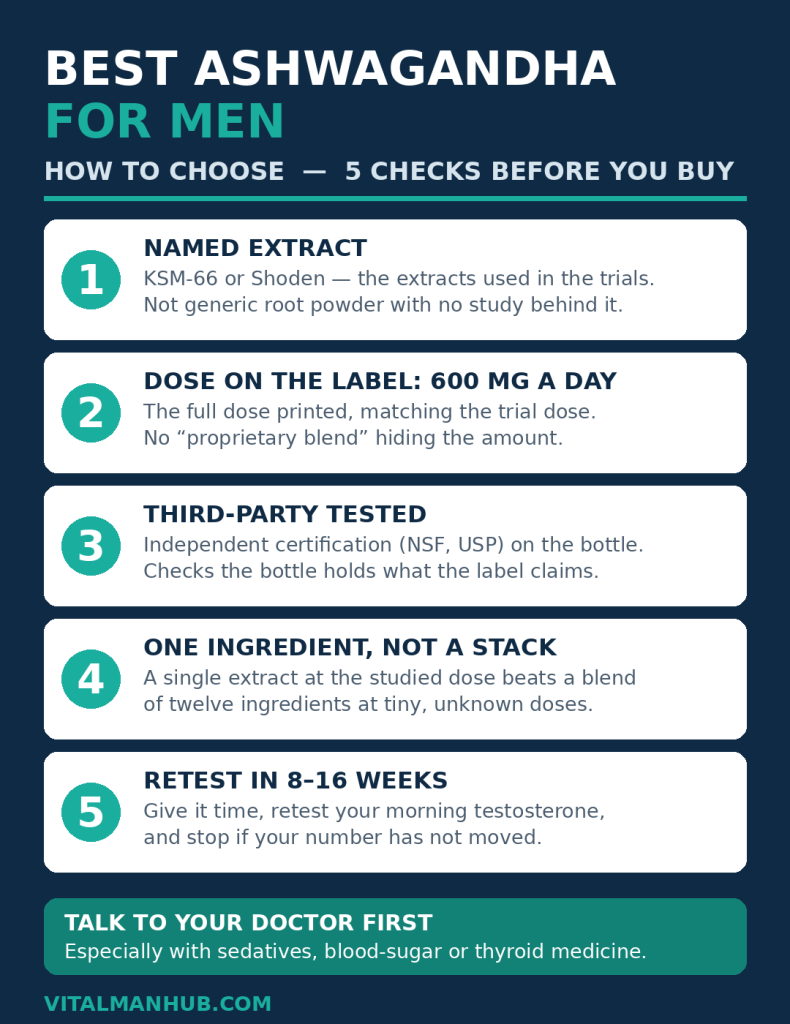
Then buy from an established seller and set a date eight to sixteen weeks out to retest. A product that passes all eight checks is the best the current evidence can point to.
What It Does NOT Do
The label will not give you this list. Ashwagandha does not replace testosterone replacement therapy — TRT is a medical treatment for confirmed, symptomatic low testosterone, prescribed and monitored by a doctor, and the Endocrine Society publishes the guidance on it. It does not turn a low result into a normal one, build muscle without training, cure erectile dysfunction, work in a week, or fix low testosterone caused by illness, medication, or a pituitary problem. Any product that claims otherwise is selling a story, not a study. That is the honest limit of the best ashwagandha for men: a modest help for the right man, not a treatment.
The Bottom Line
So what is the best ashwagandha for men? On the trials we have, the default answer is KSM-66 at 600 mg a day for eight to sixteen weeks — the most replicated evidence, a modest rise of about 15% in the right men, and the clearest dose. Shoden at 240 mg a day is the credible alternative. Generic root powder is the cheapest option — and the one with no trial behind it at all.
But the extract is only half the answer: test first, fix sleep, training, and weight, buy a named extract at the studied dose with third-party testing, and retest in eight to sixteen weeks. Then you will know — from a blood test, not a feeling — whether it did anything for you.
FAQs
Which ashwagandha is best for men?
KSM-66 at 600 mg a day has the most trial data behind it — the Wankhede 2015 and Lopresti 2019 trials both used it, and a 2023 meta-analysis found about a 14.7% testosterone rise versus placebo. Shoden at 240 mg a day is the credible alternative, with a smaller trial base. Generic root powder has no trial behind it at a known dose, so no result in this guide applies to it.
How much ashwagandha should a man take?
It depends on the extract: 600 mg a day of KSM-66 (300 mg twice a day with food), 240 mg a day of Shoden, or 125–250 mg a day of Sensoril for stress and sleep. Do not swap the doses between extracts — Shoden is far more concentrated than KSM-66. There is no studied dose for generic root powder.
How long does ashwagandha take to work for testosterone?
Allow eight to sixteen weeks, then retest with a morning testosterone test. The trials that showed any benefit ran for eight to sixteen weeks, and nothing suggests an effect in days. If your number has not moved after sixteen weeks, the product is not working for you.
Does ashwagandha lower cortisol?
Yes — that is its best-supported effect. In a 2017 trial of 64 chronically stressed adults, 300 mg of KSM-66 twice a day for sixty days cut cortisol by 27.9%, against 7.9% on placebo, and perceived-stress scores fell too. Lower cortisol is also the most likely reason testosterone rises in stressed men: cortisol brakes testosterone production, and ashwagandha loosens that brake.
Is ashwagandha safe to take every day?
Most men tolerate it at studied doses, but it is not safe for everyone. It can cause drowsiness and stomach upset, rare liver injury has been reported, and it can raise thyroid activity and add to the effects of sedatives and blood-sugar medicines. Do not take it in pregnancy, and talk to your doctor first if you take any regular medication or have liver or thyroid problems.
Can ashwagandha replace testosterone therapy?
No. Testosterone replacement therapy is a medical treatment for confirmed, symptomatic low testosterone, prescribed and monitored by a doctor. Ashwagandha raises testosterone by about 15% at most in the right men — it cannot turn a low result into a normal one, and a man with genuinely low testosterone who relies on supplements instead of seeing a doctor is delaying proper care.
Medical disclaimer
This article is for general educational purposes only and is not medical advice. It does not diagnose, treat, cure or prevent any disease. Testosterone levels vary between individuals and over the day, and symptoms of low testosterone can have many causes. Talk to your doctor or another qualified healthcare professional before changing your diet, starting supplements, or beginning a new exercise programme — especially if you have a medical condition, take medication, are pregnant or breastfeeding, or have been told you have low testosterone.
Testosterone therapy should only be started after proper testing and diagnosis by a clinician, and never bought online. If you experience chest pain, severe breathlessness, yellowing of the skin or eyes, dark urine, or any sudden serious symptom, seek urgent medical care.
For more guides on men’s vitality, visit VitalManHub.