
Table of Contents
Introduction
Every bottle on the shelf promises the same thing: more energy, more muscle, more drive. They all call themselves the best testosterone booster for men. Most of them cannot prove it.
This guide does something different. It does not rank brands, and it does not tell you which bottle to buy. Instead, it compares the ingredients inside those bottles against the actual trials behind them — what helped, by how much, in whom, and what did nothing at all. The honest answer is that there is no single best testosterone booster for men. There are a few ingredients with modest, real evidence, several that only help if you are deficient in them, and a long list that sounds impressive on a label and does very little in a blood test.
The Honest Truth First: Boosters Only Help a Proven Gap
Before any ingredient, one fact decides whether a booster can help you at all: supplements do not create testosterone out of nothing. They can only support a system that is already working, or correct a shortage that is holding it back.
That is why the same pill can look like a miracle in one trial and a dud in another. In men who were deficient in zinc, correcting the deficiency restored testosterone. In men who already had enough zinc, extra zinc did nothing. The same pattern repeats for vitamin D, and largely for the herbal ingredients too: the biggest effects show up in men who are stressed, poorly slept, or starting from low levels — not in healthy men with normal levels.
So the first step is never a shopping cart. It is the boring, unglamorous work covered in our guide on how to increase testosterone naturally: sleep seven to nine hours, train with weights, lose excess body fat, eat well, and cut back on alcohol. Those levers move testosterone more reliably than any capsule. A booster, at best, is a small addition on top of them — and only worth considering after a morning blood test has confirmed where you actually stand. Our complete guide to how to increase testosterone explains how that testing works, including the morning test, the repeat confirmation, and what a result below 300 ng/dL means.
If your levels are normal and you feel fine, no booster will push them meaningfully higher. If they are genuinely low, a booster is not a treatment either — that is a conversation for your doctor, not a supplement aisle.
How to Judge a Booster: Four Checks Before You Buy
If you still want to look at a product sold as the best testosterone booster for men, judge it by these four checks. A good product passes all four; most fail at least one.
First, the dose must be disclosed. The trials that showed any benefit used specific doses of specific extracts — 600 mg a day of KSM-66 ashwagandha, for example. If a label hides its amounts behind a “proprietary blend,” you cannot know whether it contains the studied dose or a sprinkle for decoration. No dose, no deal.
Second, the extract must match the trial. “Ashwagandha” on a label is not the same as the standardised root extract used in the trials. KSM-66 and Shoden are named extracts with published studies behind them; a generic root powder is not the same thing, even if the bottle costs the same.
Third, look for third-party testing. Independent testing (for example, NSF or USP certification) checks that the bottle contains what the label claims and is free of hidden contaminants. This matters more than it sounds: regulators have repeatedly found some “testosterone” products spiked with undeclared drugs.
Fourth, beware the stack. A product with twelve ingredients at tiny doses is usually worse than one ingredient at a real dose. More ingredients on the label is a marketing choice, not a scientific one.
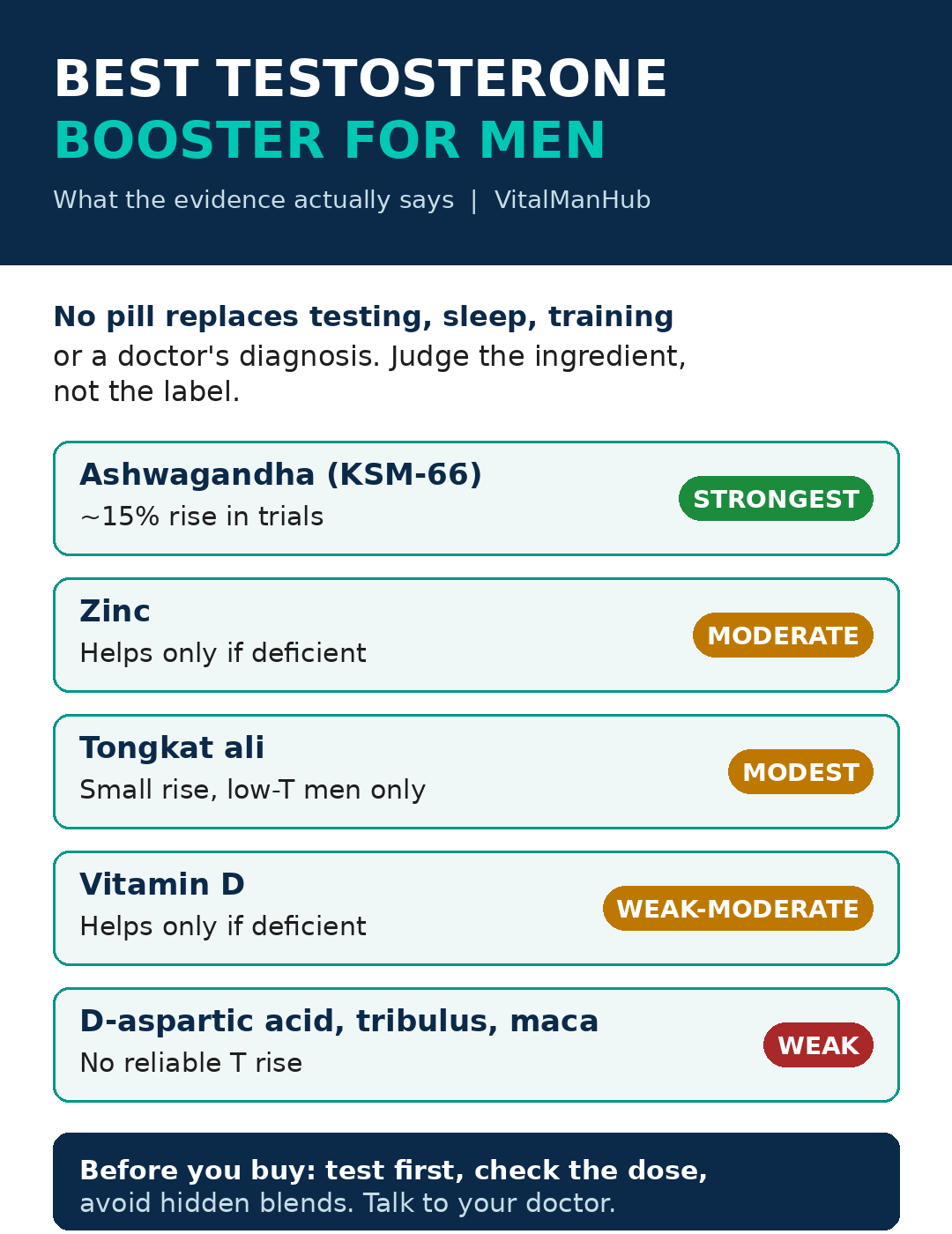
Keep those four checks in mind as you read the evidence below. The table sums up how each ingredient behind the best testosterone booster for men claims actually performed; the sections explain it.
| Ingredient | Evidence strength | What it does | Limits |
|---|---|---|---|
| Ashwagandha (KSM-66) | Strongest of the group | ~15% testosterone rise in trials | Only modest; best in stressed or training men |
| Zinc | Moderate | Restores testosterone if deficient | No rise if levels already normal |
| Vitamin D | Weak–moderate | May help if deficient | Larger trials found no clear effect |
| Tongkat ali | Modest | Small rise in men with low testosterone | Small trials, maker-funded, safety not established |
| D-aspartic acid | Weak | Mixed, unreliable results | No reliable rise in healthy men |
| Fenugreek | Weak | Some strength/libido signals | Testosterone evidence is thin |
| Maca | Weak for testosterone | Libido evidence mixed | No reliable testosterone rise |
| Tribulus | Weak | No reliable effect | Marketing ahead of evidence |
Ingredients With the Best Evidence
Ashwagandha (KSM-66): the strongest case, and still modest
Ashwagandha has the best evidence of any ingredient sold as the best testosterone booster for men — and the honest version of that sentence is that the effect is modest. A 2015 trial (Wankhede et al.) gave 57 young men doing resistance training 600 mg a day of KSM-66 for eight weeks: testosterone rose about 15% versus about 3% on placebo, alongside greater strength gains. A 2019 trial (Lopresti et al.) in overweight men aged 40–70 found a 14.7% rise over 16 weeks, and a 2023 meta-analysis pooling four trials (234 men) found the same pattern: about a 14.7% rise versus placebo.
Keep it in proportion. Fifteen percent on a level of 400 ng/dL is about 60 ng/dL. It will not turn a low result into a normal one. The effect is strongest in men whose testosterone is suppressed by stress or poor recovery, because ashwagandha lowers cortisol, the stress hormone that brakes testosterone production. It is an addition to training and sleep, not a replacement for them. The studied dose is 600 mg a day of KSM-66 for at least eight weeks.
Zinc: powerful — but only if you are short of it
Zinc is the clearest example of the deficiency rule. In the classic study (Prasad et al., 1996), four young men on a zinc-restricted diet for 20 weeks saw testosterone fall from 39.9 to 10.6 nmol/L, while nine marginally zinc-deficient older men given zinc for six months saw theirs rise from 8.3 to 16.0 nmol/L. Correcting a real deficiency genuinely restores testosterone.
But there is no reliable evidence that extra zinc raises testosterone in men who already get enough. If your diet includes meat, shellfish, chickpeas, or nuts, you are probably not deficient, and a zinc pill will not move your number. Do not exceed 40 mg a day of supplemental zinc: above that, it can cause nausea, copper deficiency, and a weakened immune system. If you suspect a deficiency, test first.
Vitamin D: the most tested, and the most disappointing
Vitamin D has been tested more rigorously than any other ingredient here. Men with low vitamin D do tend to have lower testosterone — but that may simply reflect shared ill health, not cause and effect.
One small 2011 trial (Pilz et al.) in 54 overweight men who started deficient found that about 3,300 IU a day for a year raised total testosterone from 10.7 to 13.4 nmol/L. Yet a later trial in 98 healthy men (20,000 IU a week for 12 weeks) found no effect at all, and a meta-analysis pooling eleven randomised comparisons found no clear effect on total testosterone. The fair summary: correcting a true deficiency may help a little; supplementing on top of adequate levels does not. Get your level checked — many men are deficient, especially in winter — but do not buy vitamin D expecting a boost if your level is already fine.
Tongkat ali: a small rise, honestly stated
Tongkat ali (Eurycoma longifolia) has the loudest marketing and the most modest trial record. The largest trial (Chinnappan et al., 2021) enrolled 105 men aged 50–70 with testosterone below 300 ng/dL and gave them 100 or 200 mg a day of a standardised extract (Physta) or placebo for 12 weeks. Total testosterone rose more than placebo — from about 200 to about 225 ng/dL on the higher dose — but every group was still below 300 ng/dL at the end, and free testosterone did not differ from placebo.
Smaller trials in stressed men reported larger percentage rises, but they are small, short, and mostly funded by the extract’s maker. In 2021, the European Food Safety Authority concluded that the safety of a standardised tongkat ali extract “has not been established under any condition of use.” A small rise in men with genuinely low levels is a real signal — but it is a long way from the numbers on supplement websites, and not a reason to skip testing or a doctor’s visit.
Ingredients With Weak or Mixed Evidence
D-aspartic acid
D-aspartic acid is an amino acid involved in hormone signalling, and early small studies suggested it might raise testosterone. Later, better trials did not confirm it: in healthy, training men, results were mixed, with some studies finding no effect and at least one finding a fall at higher doses. There is no reliable basis for calling it the best testosterone booster for men, and no settled dose.
Fenugreek
Fenugreek has some small trials suggesting improvements in strength and libido, and a few reporting modest testosterone rises — but the trials are small, short, and inconsistent, and several were funded by manufacturers. The libido signal is more interesting than the testosterone signal, and neither is strong enough to build a buying decision on.
Maca
Maca is widely sold for male vitality, and it deserves a fair hearing: some trials report improved libido and sexual wellbeing. But libido is not testosterone. Across the trials, maca has shown no reliable rise in testosterone itself. If desire is the issue, that distinction matters — and it is another reason to test before assuming a hormone problem.
Tribulus
Tribulus terrestris is the oldest name on this list and the weakest. Despite decades on supplement labels, controlled trials have consistently failed to show a reliable testosterone rise in men. Its reputation rests on tradition and marketing, not on blood tests.
What to Avoid
Some products sold as the best testosterone booster for men are not merely ineffective; they are risky. Walk away from anything that promises “guaranteed results,” a “permanent increase,” or a “cure” — those words are a confession that the seller is not following the evidence. Avoid products that hide doses in proprietary blends, stack a dozen ingredients at unknown amounts, or claim “clinically proven” without naming a single trial. Be especially careful with products bought online from unknown sellers: regulators have found some “natural testosterone boosters” contaminated with undeclared prescription drugs, including actual testosterone and erectile-dysfunction medicines. A product that secretly contains a drug is not a supplement; it is an unlabelled medicine with unlabelled risks.
If you take any regular medication, have prostate, liver, or heart problems, or have been told you have low testosterone, talk to your doctor before taking any booster. Ashwagandha can interact with sedatives and blood-sugar medicines; zinc in high doses interferes with copper and some antibiotics; tongkat ali’s safety profile is, as noted above, not established.
How to Choose Safely: Your Checklist
If, after testing and after the lifestyle work, you still want to try one ingredient sold as the best testosterone booster for men, use this checklist. It is the whole article in seven lines.
| Check | What to look for |
|---|---|
| Test first | Morning testosterone test, repeated if low — know your number before you buy |
| One ingredient | A single ingredient at the studied dose beats a twelve-ingredient blend |
| Named extract | KSM-66 or Shoden for ashwagandha; Physta for tongkat ali — not generic powder |
| Dose disclosed | The full dose on the label, matching the trial dose |
| Third-party tested | Independent certification (e.g. NSF, USP) on the bottle |
| Honest claims | No “guaranteed,” “cure,” or “permanent” promises anywhere on the label |
| Doctor first | Tell your doctor, especially if you take medication or have a health condition |
And then, the part nobody selling supplements will tell you: give it eight to twelve weeks, retest, and stop if nothing changed. A booster that works should show up in a blood test, not just in how the bottle makes you feel. If your number has not moved, you have your answer — and the money is better spent on sleep, training, and food.
The Bottom Line
So what is the best testosterone booster for men? There is no single winner, and anyone selling you one is selling a story, not a study.
The closest thing to an honest answer is a short list, in order: first, test your levels and fix sleep, training, and body fat. Then, if a gap is proven, ashwagandha (KSM-66, 600 mg a day) has the most replicated evidence — a modest rise of about 15% in the right men. Zinc and vitamin D help only if you are deficient in them, and testing is cheaper than guessing. Tongkat ali shows a small rise in men with low testosterone, honestly stated and not oversold. Everything else on the shelf — D-aspartic acid, fenugreek, maca, tribulus — has weak or mixed evidence for testosterone itself, whatever the label claims.
That is a less exciting answer than the adverts offer. It is also the only one the trials support. A man who tests first, fixes the foundations, and chooses one ingredient by its evidence will spend less, risk less, and know — from a blood test, not a feeling — whether anything actually worked.
FAQs
Do testosterone boosters really work?
Some ingredients work a little, in the right men. Ashwagandha (KSM-66) raised testosterone by about 15% in trials of stressed and training men, and zinc restores testosterone when a man is genuinely deficient. But no over-the-counter booster reliably raises testosterone in healthy men with normal levels, and none replaces medical treatment for confirmed low testosterone.
Which ingredient has the best evidence?
Of all the ingredients sold as the best testosterone booster for men, ashwagandha — specifically the standardised extract KSM-66 at 600 mg a day for at least eight weeks — has the strongest case. Four pooled trials found about a 14.7% rise versus placebo. It is the strongest case in this group — and still a modest effect, not a transformation.
Are testosterone boosters safe?
Most single-ingredient boosters at studied doses are reasonably well tolerated, but they are not risk-free. High-dose zinc can cause copper deficiency, ashwagandha can interact with sedatives and blood-sugar medicines, and tongkat ali’s safety has not been established by European regulators. Products bought online carry an extra risk of hidden drug ingredients. Tell your doctor before starting one.
How long before a booster works?
Allow eight to twelve weeks, then retest. The trials that showed any benefit ran for eight to sixteen weeks. If a morning blood test shows no change after three months, the product is not working for you, and continuing it is wasted money.
Can a booster replace TRT?
No. Testosterone replacement therapy is a medical treatment for confirmed, symptomatic low testosterone, prescribed and monitored by a doctor. A supplement cannot replace it, and a man with genuinely low testosterone who relies on boosters instead of seeing a doctor is delaying proper care. See our complete guide to how to increase testosterone for how testing and treatment actually work.
Should men over 50 take a booster?
Only after testing. Testosterone falls about 1% a year from around age 30–40, but age alone is not a reason to supplement. Men over 50 were the group in the tongkat ali trial that showed a small rise — and also the group most likely to have other health conditions and medicines that interact with supplements. Test first, talk to your doctor, and fix sleep, training, and weight before buying anything.
Medical disclaimer
This article is for general educational purposes only and is not medical advice. It does not diagnose, treat, cure or prevent any disease. Testosterone levels vary between individuals and over the day, and symptoms of low testosterone can have many causes. Talk to your doctor or another qualified healthcare professional before changing your diet, starting supplements, or beginning a new exercise programme — especially if you have a medical condition, take medication, or have been told you have low testosterone. Testosterone therapy should only be started after proper testing and diagnosis by a clinician, and never bought online. If you experience chest pain, severe breathlessness or any sudden serious symptom, seek urgent medical care.
For more guides on men’s vitality, visit VitalManHub.
Pingback: Best Ashwagandha for Men: How to Choose
Pingback: Benefits of Ashwagandha for Men: The Evidence
Pingback: Maca Root for Men: What the Evidence Shows