

Introduction
Turning 40 changes the conversation about testosterone. In your twenties, a flat month at work or a few bad nights barely moved anything. After 40, the same tiredness, softer waistline and quieter sex drive can mean something slower is happening underneath — your testosterone has been drifting down for years, and the habits that used to carry you no longer cover for it.
This VitalManHub guide explains how to increase testosterone after 40: why it falls at this age, how to test it properly, the five levers that matter most now, and when the right move is a doctor rather than a supplement. Everything here is evidence-based, and honest about what works, what helps a little, and what does not work at all.
Table of Contents
- Introduction
- Why 40 Is a Turning Point
- The Symptoms Worth Paying Attention To
- Reading Your Result at 40
- How Testing Works After 40
- The 5 Levers That Matter Most After 40
- Supplements and Boosters at 40 — A Short, Honest Word
- TRT After 40: A Doctor’s Decision, Not a Purchase
- What to Expect — Timelines at 40
- Your First 8 Weeks
- Conclusion
- Frequently Asked Questions
Why 40 Is a Turning Point
Testosterone falls by about 1% a year from around age 30 to 40, according to the NHS. That sounds small, but by 40 you have been losing ground for a decade — a tenth down from your peak.
Two things make 40 different from 30. First, levels of sex hormone binding globulin (SHBG) — the protein that ferries testosterone around in the blood — tend to climb as you get older. Most testosterone travels bound to SHBG and albumin; only the small unbound part, free testosterone, is available for your tissues to use. So free testosterone can fall faster than total testosterone after 40, even when the total still looks reasonable.
Second, the conditions that push testosterone down become more common in your forties: extra weight around the middle, type 2 diabetes, poor sleep and untreated sleep apnoea, heavy drinking, and some medicines. That is the real question behind how to increase testosterone after 40 — not one magic fix, but which of these is actually dragging your number down.
There is also a recovery gap: in your twenties you could train hard and sleep badly and still feel fine the next day. After 40, recovery is slower, muscle is harder to keep, and the same lifestyle costs you more — which means the levers matter more, not less.
The Symptoms Worth Paying Attention To
The clearest warning signs of low testosterone are sexual ones: lower desire, fewer morning erections that happen on their own, and difficulty getting or keeping an erection. Those three clustered most reliably with low levels in the large European Male Ageing Study of 3,369 men aged 40 to 79. One figure from that study is worth holding on to: 17% of the men had a low reading on a single test, yet only 2.1% had the full picture — a low level together with symptoms.
The remaining signs are genuine but much vaguer: ongoing tiredness, low mood, irritability, trouble concentrating, shrinking muscle, growing belly fat and broken sleep. The NHS is clear that in many cases these symptoms have nothing to do with hormones — stress, depression, anxiety, poor sleep, a poor diet or lack of exercise are more often the cause. After 40, thyroid problems, low iron, B12 deficiency, diabetes, heart disease and some medicines can copy the same picture.
So at this age neither symptoms on their own nor a single number can settle the question. You need symptoms and a proper measurement together — plus a check for everything else that could explain them.
Reading Your Result at 40
| Total testosterone | What it usually means |
|---|---|
| About 300–1,000 ng/dL | The commonly quoted healthy adult range |
| Below about 300 ng/dL | Generally considered low — but only a diagnosis with symptoms and a second test |
| Borderline, around 300 ng/dL | Retest, check SHBG and free testosterone, and look at LH and FSH |
| Free testosterone low while total looks fine | Possible after 40 — SHBG rises with age, so ask your doctor about it |
How Testing Works After 40
When symptoms have hung around for weeks, a blood test comes before any supplement. The details of the test matter, and they are the first practical step in how to increase testosterone after 40, because you cannot fix a number you have not measured properly.
The blood sample should be taken in the morning, ideally between 7 and 10am when levels are at their peak, and ideally after fasting. A low result has to be checked again on a different morning before it counts as a diagnosis, since levels shift from day to day and drop while you are unwell.
When the result lands in the borderline zone, your clinician may add an SHBG measurement and a free testosterone calculation, plus LH and FSH, to find out whether the fault lies in the testicles or in the brain signals that drive them. Your doctor will also ask about weight, blood sugar, sleep, mood and medicines — all of them can move the number.
One age-specific note: as you approach 50, your doctor may also order a prostate-specific antigen (PSA) test, because testosterone treatment is not started without knowing the prostate position. Our guide to the best testosterone booster for men over 50 covers the over-50 testing picture in more detail.
Home test kits cannot diagnose low testosterone. A finger-prick or saliva kit can hint at a level, but a diagnosis needs a proper morning laboratory blood test, repeated to confirm.
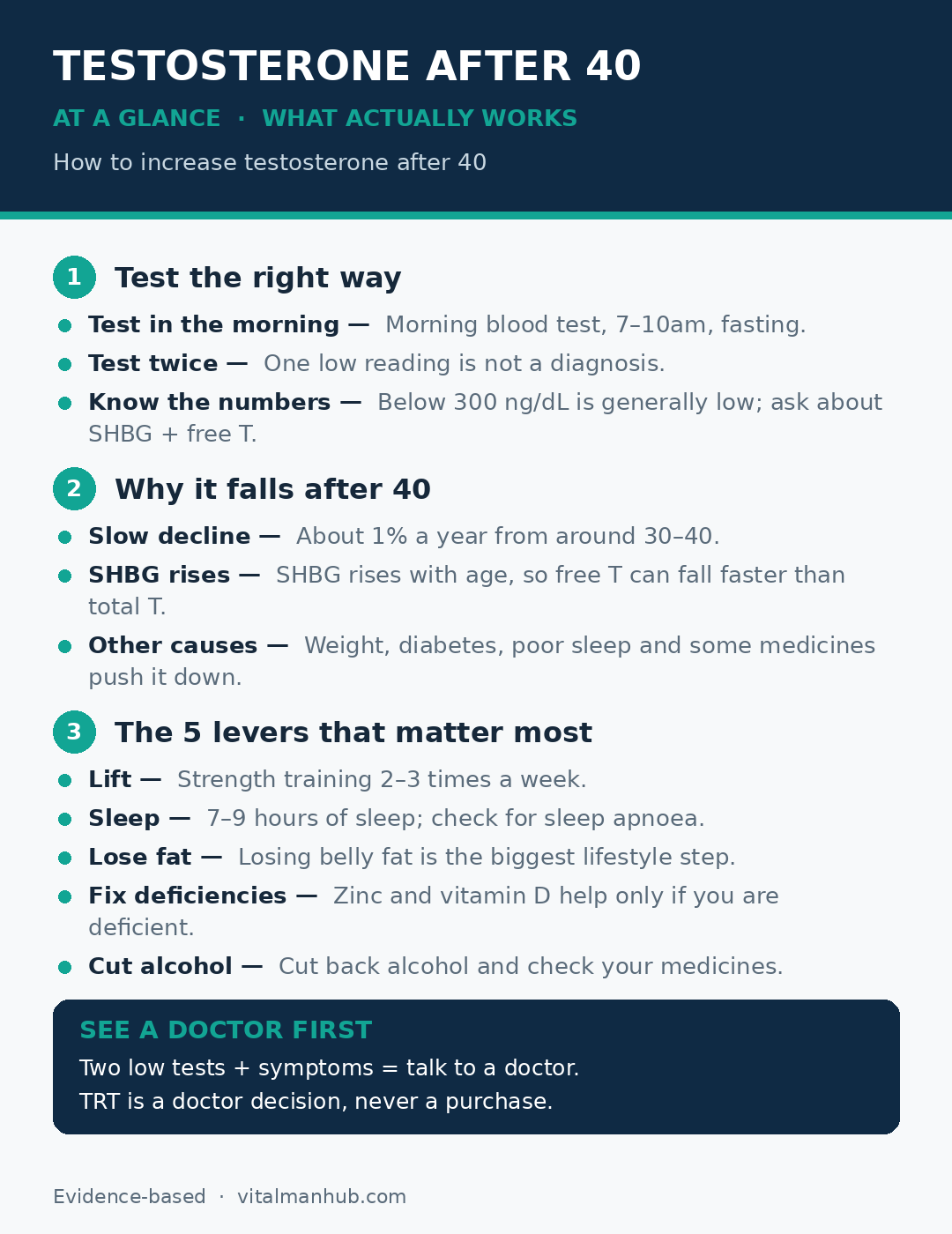
The 5 Levers That Matter Most After 40
Our guide on how to increase testosterone naturally covers the natural levers in depth for all ages. This section ranks them for your forties — what to do first, and what changes at this age, so you can see how to increase testosterone after 40 without a prescription.
1. Lift for Strength, Not for Ego
Strength training two to three times a week is the most reliable exercise lever after 40. Compound lifts — squats, deadlifts, bench press, rows — build the muscle that age and low testosterone both erode, and protect bone, balance and mood even if the number barely moves.

At this age, form and recovery matter more than the weight on the bar. Warm up properly, progress slowly, and leave a day between sessions for the same muscle group. Short, focused sessions beat long, exhausting ones: overtraining raises cortisol, which works against testosterone. Add a daily walk outdoors in daylight — it supports sleep, mood and weight too.
2. Protect Your Sleep
Most daily testosterone is made during deep sleep in the early hours of the morning, so short sleep cuts production directly. In a controlled study, one week of five-hour nights cut daytime testosterone by 10–15% in healthy young men (Leproult, 2011) — and after 40, untreated sleep apnoea is one of the most common hidden causes of a low reading.
Get seven to nine hours on a steady schedule, in a cool dark room, and leave your phone outside the bedroom half an hour before you sleep. Skip alcohol in the evening — it breaks up the deep sleep your body needs. If you snore heavily or wake up unrefreshed, get that checked before any supplement: treating apnoea can change the number on its own.
3. Lose the Belly Fat First
If you carry significant extra fat around the middle, losing it is the single biggest lifestyle step for testosterone after 40. Body fat turns testosterone into oestrogen, so carrying more fat usually leaves less testosterone available — and low testosterone makes gaining fat easier in return.
The fix is not a crash diet. Aim for a steady calorie deficit — smaller portions, fewer sugary drinks and processed snacks, more protein and vegetables — plus the training from step one to protect muscle. Men who lose a serious amount of weight tend to see the biggest testosterone gains of any lifestyle change — spread over months, not days. After 40 this matters even more, because belly fat and type 2 diabetes travel together.
4. Fix a Real Deficiency — Nothing More
Zinc and vitamin D have the clearest link to testosterone, but only when you are actually deficient in them. Men genuinely low in zinc see levels recover when they correct it, and low vitamin D is linked with lower testosterone. If your levels are already normal, extra zinc or vitamin D will not push testosterone higher — it only fills a gap.
Only a blood test shows whether you are truly deficient — guessing never will. Megadoses are a risk, not a shortcut: too much zinc can cause nausea and copper deficiency. Oysters, red meat and pumpkin seeds give you zinc; oily fish, eggs and sunlight give you vitamin D. Supplements fill a proven gap — they do not chase a number.
5. Cut Alcohol and Review Your Medicines
Heavy alcohol use suppresses testosterone production over time, and it also wrecks the deep sleep that makes most of your daily testosterone. Cutting back in the evenings helps on both counts at once.
Some medicines lower testosterone as a side effect, including opioids, oral steroids, and some antipsychotics and anticonvulsants. Never stop a prescribed medicine on your own; ask your doctor whether it could be contributing, and whether an alternative exists. That one conversation is free, and it can matter more than any supplement.
Supplements and Boosters at 40 — A Short, Honest Word
Most testosterone boosters have modest evidence at best, and the honest picture at 40 is the same as at any age: no bottle replaces the five levers above. Tongkat ali has the strongest trial of any ingredient — and it was done in men aged 50 to 70, with total testosterone rising from about 200 to about 225 ng/dL over 12 weeks, still below the level generally considered low. Our guide to the best testosterone booster for men over 50 gives the full verdict on that trial and the other ingredients.
Ashwagandha showed rises of around 15% in stressed men, but those trials were mostly in younger men, so the over-40 evidence is indirect. Maca has mixed evidence for libido and no convincing evidence for raising testosterone itself. The evidence for D-aspartic acid, fenugreek and tribulus is weak or all over the place, and tribulus shows no dependable testosterone lift whatsoever.
If you do try one, pick a single ingredient at a stated dose, from a brand with third-party testing, and avoid “proprietary blends” with no doses listed — you cannot judge what you cannot see. Judge it after testing, not before.
TRT After 40: A Doctor’s Decision, Not a Purchase
Testosterone replacement therapy (TRT) is a real medical treatment for confirmed low testosterone with symptoms — it is not an anti-ageing treatment, and it is not for healthy men who simply want higher numbers. Doctors only consider it once two morning tests have confirmed low levels alongside symptoms, and they start it and watch it themselves. That testing-first rule is central to how to increase testosterone after 40 safely — treatment follows proof, not a feeling. For the full picture of testing and treatment, see our overview of how to increase testosterone.
The large TRAVERSE trial in 2023 (5,246 men, New England Journal of Medicine) found no excess of major cardiovascular events on testosterone versus placebo — but more atrial fibrillation, pulmonary embolism, kidney injury and fractures. That is why treatment means monitoring — prostate checks, red blood cell count, cholesterol and blood pressure — not just a prescription.
Two cautions matter at this age. For one thing, TRT shuts down sperm production and your own testosterone output, which rules it out for men hoping to have children. Second, there is limited experience on its safety in men over 65, and guidance says it should not be routinely prescribed to all men once they reach 65 with a low reading — the decision is individual and specialist-led.
Never buy testosterone online. It is a prescription-only controlled medicine, and treating yourself is dangerous — the dose, the follow-up blood work and the prostate checks are as much the treatment as the hormone itself.
What to Expect — Timelines at 40
Sleep improves within a week or two. Training and fat loss take 8 to 12 weeks to show clearly, and a blood test after about three months of steady habits is a fair check. That timeline is part of how to increase testosterone after 40 realistically: the levers work, but they work on a calendar of months, not days.
Do not expect a return to your numbers at 25. After 40 the goal is not a peak reading — it is energy, strength, sleep and health, with symptoms under control. If three months of real effort changes how you feel but not the number, that is still progress — and useful information for your doctor.
Your First 8 Weeks
| Week | Focus | Do this |
|---|---|---|
| 1–2 | Sleep + test | Book a morning blood test (7–10am, fasting); fixed bedtime, 7–9 hours |
| 3–4 | Training | Two full-body strength sessions a week, plus a 30-minute walk daily |
| 5–6 | Food | Protein at every meal, zinc-rich foods 3 times a week, cut sugary drinks |
| 7–8 | Review | Check for sleep apnoea signs, alcohol and medicines; plan a retest with your doctor |
Conclusion
The honest answer to how to increase testosterone after 40 is unglamorous: test first, then give your body what it needs — lift, sleep, lose the belly fat, fix only a proven deficiency, and cut back alcohol. Supplements are a small footnote, and treatment is a doctor’s decision for confirmed cases only.
Book the blood test this week, sleep better tonight, add training next week. The numbers follow the habits — and so does how you feel, in the gym, at work and at home.
Frequently Asked Questions
How to increase testosterone after 40?
Test first — a morning blood test between 7 and 10am, repeated to confirm — then work the five levers: strength training 2–3 times a week, 7–9 hours of sleep, losing belly fat, correcting only a proven zinc or vitamin D deficiency, and cutting back alcohol. If two tests confirm low testosterone with symptoms, discuss treatment with your doctor.
What is a normal testosterone level after 40?
There is no single “normal for 40” number — levels fall slowly with age and vary between men. The commonly quoted healthy adult range is about 300–1,000 ng/dL, and below about 300 ng/dL is generally considered low. Symptoms matter as much as the number, and free testosterone matters too, because SHBG rises with age.
Should I get my testosterone tested at 40?
Yes, if symptoms persist for weeks — very low energy, low sex drive, erection problems, low mood, or muscle loss despite training. Only a morning blood test, done twice to confirm, can tell you for certain. Testing at 40 also gives you a baseline to compare against later.
Can exercise raise testosterone after 40?
Strength training is the most reliable exercise lever at this age. It builds and protects muscle and supports bone and mood, even if the testosterone number itself moves only modestly. Two to three sessions a week of compound lifts, with recovery days between them, is enough — more is not better after 40.
Do testosterone boosters work after 40?
At best, a little — and only when the situation is right. The best-studied ingredient, tongkat ali, raised total testosterone from about 200 to about 225 ng/dL in men aged 50–70 over 12 weeks — still below the level generally considered low. Most other ingredients have weak or mixed evidence, and none replaces testing, lifestyle change, or treatment when treatment is needed.
Is TRT safe after 40?
It is proper medical treatment with proper monitoring — nothing like an over-the-counter supplement. It is considered only for confirmed low testosterone with symptoms. The TRAVERSE trial found no excess of major cardiovascular events, but more atrial fibrillation, blood clots, kidney injury and fractures on testosterone, so prostate, red blood cell count and heart health are monitored. Never buy it online.
Medical disclaimer
This article is for general educational purposes only and is not medical advice. It does not diagnose, treat, cure or prevent any disease. Testosterone levels vary between individuals and over the day, and symptoms of low testosterone can have many causes. Talk to your doctor or another qualified healthcare professional before changing your diet, starting supplements, or beginning a new exercise programme — especially if you have a medical condition, take medication, or have been told you have low testosterone. If you are considering testosterone therapy, it should only be started after proper testing and diagnosis by a clinician. If you experience chest pain, severe breathlessness or any sudden serious symptom, seek urgent medical care.
For more guides on men’s vitality, visit VitalManHub.