
Table of Contents
Introduction
Walk into any supplement shop and you will find these two roots on the same shelf. One is tongkat ali, a Southeast Asian root sold as a direct testosterone herb. The other is ashwagandha, an Ayurvedic root sold as a stress herb that happens to lift testosterone too. They cannot both be the best choice for the same man.
This VitalManHub guide settles tongkat ali vs ashwagandha for men the only honest way: by putting the trials side by side — what each one did, in whom, at what dose, and which one fits your goal.
The Short Answer
If you only want the verdict, here it is. Ashwagandha has the stronger case for testosterone: its rise of about 15% was found in two separate trials and then again in a pooled analysis of four trials, all using the same extract at the same dose. Tongkat ali has the more direct story — it was tested in men who actually had low testosterone — but the rise was small, from about 200 to about 225 ng/dL.
So the choice is not “which herb is stronger” but “which problem are you trying to fix”. A stressed man with poor sleep and a low-normal reading is an ashwagandha man. An older man with a confirmed low reading who has already fixed sleep, training and weight might look at tongkat ali — after talking to his doctor, because its safety has not been established. A healthy man with a normal reading should expect little from either one.
At a Glance
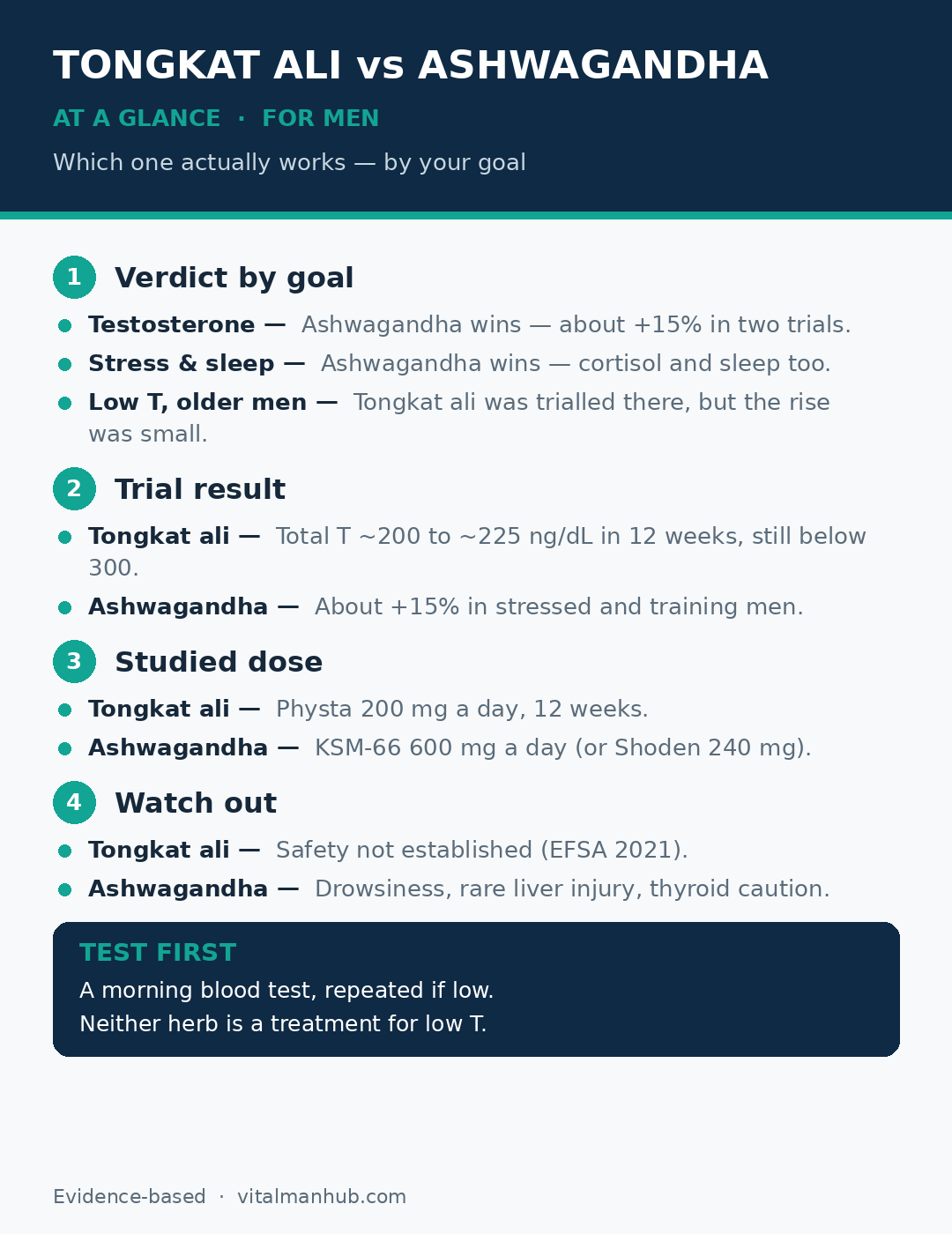
| Tongkat ali | Ashwagandha | |
|---|---|---|
| Where it comes from | Root of Eurycoma longifolia, Southeast Asia | Root of Withania somnifera, India |
| How it is thought to work | Acts more directly on testosterone in men with low levels | Eases the cortisol brake that holds testosterone down |
| Best trial result | Total T ~200 to ~225 ng/dL in 12 weeks (men 50–70, low T) | About +15% testosterone in stressed and training men |
| Studied dose | 200 mg a day of standardised extract (Physta) | 600 mg a day of KSM-66 (or 240 mg of Shoden) |
| Trial base | One main trial in low-T men, plus small stressed-men trials | Two independent trials plus a 4-trial pooled analysis |
| Main watch-out | Safety not established (EFSA 2021) | Drowsiness, rare liver injury, thyroid and sedative interactions |
What Each One Is
Tongkat ali is the root of Eurycoma longifolia, a shrub from the rainforests of Malaysia and Indonesia with a long history as a traditional tonic for men. The trials did not test the raw root: they tested Physta, a standardised water extract, at 100 or 200 mg a day.
Ashwagandha is the root of Withania somnifera, a shrub used in Ayurvedic medicine for thousands of years and often described as an adaptogen — a plant said to help the body handle stress. Its active compounds are withanolides, and their amount varies from root to root, so the trials tested named extracts with a fixed content: KSM-66, a root-only extract with more than 5% withanolides, and Shoden, a root-and-leaf extract with 35% withanolide glycosides.
How They Work — Two Different Routes
This is where tongkat ali vs ashwagandha for men gets interesting, because the two herbs do not do the same job.
Ashwagandha works through stress. When pressure stays high for weeks, the stress hormone cortisol stays high with it, and cortisol brakes testosterone production by dampening the brain signals that tell the testes to work. Ashwagandha loosens that brake: in a 2017 trial of 64 chronically stressed adults, 300 mg of KSM-66 twice a day for sixty days cut cortisol by 27.9%, against 7.9% on placebo. That is why the biggest testosterone rises show up in stressed men, poor sleepers and men in hard training. In a relaxed man with a normal reading, there is far less to gain.
Tongkat ali’s route is less well mapped. Nobody has nailed down its mechanism in men the way ashwagandha’s cortisol route has been shown; the leading ideas — that it nudges the body’s own production and frees up more of the testosterone already there — come from laboratory and animal work, not from human trials. What it does have is a trial in the men who matter most here: men aged 50 to 70 whose testosterone was already below 300 ng/dL.
The Evidence Head-to-Head
In the head-to-head evidence for tongkat ali vs ashwagandha for men, ashwagandha has been tested more often, in more men, with the same result each time; tongkat ali has been tested once properly in low-testosterone men, with a small result.
| Trial | Who was studied | What they took | What happened |
|---|---|---|---|
| Chinnappan 2021 (tongkat ali) | 105 men aged 50–70, testosterone below 300 ng/dL | Physta 100 or 200 mg a day, 12 weeks | Total T rose from about 200 to about 225 ng/dL on 200 mg — still below 300; free T no different from placebo |
| Wankhede 2015 (ashwagandha) | 57 young men on a resistance-training programme | KSM-66 600 mg a day, 8 weeks | Testosterone up about 15% vs about 3% on placebo, with bigger strength gains |
| Lopresti 2019 (ashwagandha) | 60 overweight men aged 40–70 | KSM-66 600 mg a day, 16 weeks | Testosterone up 14.7% vs placebo; DHEA-S up about 18% |
| 2023 pooled analysis (ashwagandha) | 234 men across 4 trials | KSM-66 600 mg a day | About a 14.7% rise vs placebo — the same trials pooled, not new men |
Read the ashwagandha figure carefully. The 2023 pooled analysis found the same 14.7%, but it pools the trials above — the same men counted a second time. It strengthens the case without adding a single new man, and no ashwagandha trial ran longer than sixteen weeks. Even so, two independent trials landing on the same number beats one trial standing alone. Tongkat ali’s smaller trials in stressed men reported larger rises, but they are small, short and mostly funded by the extract’s maker, so they carry less weight.
Keep both results in proportion: 15% on 400 ng/dL is about 60 ng/dL, and a rise from 200 to 225 ng/dL is 25 ng/dL. Neither turns a low result into a normal one. Our comparison of the best testosterone booster for men reaches the same conclusion across all eight ingredients, and our guide to the best ashwagandha for men goes deeper on the ashwagandha trials.
Doses Used in the Trials
Doses are where tongkat ali vs ashwagandha for men differ most sharply.
Tongkat ali’s studied dose is 200 mg a day of Physta for 12 weeks; the ~225 ng/dL figure came from that dose. No trial supports a higher dose, and generic root powder has no studied dose — the result belongs to the extract, not to the plant.
Ashwagandha’s studied dose is 600 mg a day of KSM-66 — 300 mg twice a day with food — for 8 to 16 weeks. Shoden is dosed at 240 mg a day; do not take 600 mg of Shoden. Generic root powder has no studied dose, so no trial result applies to it.
Allow eight to twelve weeks, then retest with a morning blood test. If the number has not moved after sixteen weeks, the product is not working for you — do not raise the dose, because no trial supports a higher one for either herb.
Who Each One Suits
The right herb depends on the man in front of it, not on the label.
Ashwagandha suits the man whose testosterone is held down by stress and poor recovery: sustained pressure, broken sleep, hard training, and a low-normal level with a stressful life behind it. The men in the Lopresti trial — overweight, aged 40 to 70 — matched that description, and their readings moved the most. It also suits the man who wants the sleep and stress help as much as the testosterone.
Tongkat ali suits a narrower group: an older man with a confirmed low reading — below 300 ng/dL, tested twice, with symptoms — who has already sorted sleep, training and weight and still wants to try the one ingredient trialled in men like him. Even then the gain is small, so a doctor’s advice comes before the purchase.
Neither suits a healthy man with a normal reading who simply wants a higher number — no trial shows a meaningful rise in that man for either herb. Neither is a treatment for genuinely low testosterone: that is a medical decision, and the Cleveland Clinic’s guide to low testosterone explains how testing and diagnosis work.
Side Effects and Safety
The safety pictures are different too — and for tongkat ali, the honest answer is that the picture is incomplete.
Tongkat ali’s main caution is not a side effect but a gap: in 2021, the European Food Safety Authority concluded that the safety of a standardised tongkat ali extract “has not been established under any condition of use.” The trials reported it as generally well tolerated, with mild stomach upset and headache the most common complaints. That is a thin record for a daily supplement — talk to a doctor first, especially if you take diabetes or blood-pressure medicine.
Ashwagandha’s cautions are better documented. The common ones are mild: drowsiness, stomach upset, diarrhoea and nausea — plan around the drowsiness and take it in the evening. The serious one is rare but real: liver injury has been reported two to twelve weeks after starting, usually settling within months of stopping, though severe cases needing a transplant have been reported. If your skin or eyes turn yellow, your urine darkens, or nausea and pain in the upper right of the belly will not go away, stop taking it and get medical help straight away.
It can also raise thyroid activity, so it is not for anyone with hyperthyroidism or borderline thyroid function; it adds to the effects of sedatives and alcohol and may lower blood sugar, so tell your doctor if you take sleeping pills, anxiety medicines or diabetes medicine. Do not take it in pregnancy. Denmark has banned it outright.
On balance, ashwagandha has the better-known safety record. Tongkat ali has fewer reported problems and a bigger unknown.
Can You Take Both Together?
It is a natural question in any tongkat ali vs ashwagandha for men comparison — if one helps a little and the other helps a little, why not stack them? No trial has ever tested the two together for testosterone, so nobody knows whether they add up, cancel out, or interact. Every number in this guide comes from a trial of one herb on its own.
Stacking also creates a practical problem: start both at once and you cannot tell which one moved your number — or which one to blame if you feel unwell. Try one herb at a time, at the studied dose, for eight to sixteen weeks, with a blood test before and after.
The Verdict by Goal
The winner of tongkat ali vs ashwagandha for men changes with the goal.
For testosterone: ashwagandha, by a clear margin — two independent trials plus a pooled analysis, all near +15%, beats one trial showing a 25 ng/dL rise.
For stress and sleep: ashwagandha, and it is not close. Cortisol fell by 27.9% in the stressed-adults trial, and the sleep trials point the same way. Our guide to the benefits of ashwagandha for men covers those findings.
For libido: neither, honestly. Tongkat ali’s smaller trials reported mood and libido signals, but libido is not testosterone, and neither herb has strong proof here.
For training and recovery: ashwagandha. The Wankhede trial’s men gained more strength and muscle than placebo over eight weeks of identical training — most likely through better recovery, not a hormone surge.
For an older man with confirmed low testosterone: tongkat ali is the only one of the two trialled in that group — but the rise was small, the men stayed below 300 ng/dL, and the safety record is unfinished. A doctor-first decision, not a shopping decision.
How to Choose: Your Checklist
If you decide to try one of them, use this checklist before you buy.
- Test first — a morning testosterone test, repeated if low, so you know your number before you spend anything
- Pick by your goal — stress and sleep point to ashwagandha; confirmed low T in an older man is the only case for tongkat ali
- Named extract at the studied dose — Physta 200 mg a day, KSM-66 600 mg a day or Shoden 240 mg a day; no generic powder, no proprietary blend
- Third-party tested — independent certification on the bottle
- One ingredient only — a single extract at a real dose beats a blend of twelve at unknown amounts
- Doctor first — especially with sedatives, blood-sugar or thyroid medicine
- Retest in 8–16 weeks — a supplement that works should show up in a blood test
- Stop if nothing changed — continuing it is wasted money
Conclusion
Tongkat ali vs ashwagandha for men is not a contest between a good herb and a bad one. It is a choice between two modest helpers that work in different ways, were tested in different men, and fit different goals. Ashwagandha has the stronger, more repeated evidence — about a 15% testosterone rise in stressed and training men, plus real stress and sleep help. Tongkat ali has the more direct story, tested in men who actually had low testosterone, but the rise was small.
Whichever one fits your goal, the order stays the same: test first, fix sleep, training and weight, buy a named extract at the studied dose, and retest in eight to sixteen weeks.
Frequently Asked Questions
Tongkat ali vs ashwagandha for men — which is better for testosterone?
Ashwagandha has the stronger evidence: two independent trials and a pooled analysis of four trials all found about a 15% testosterone rise with KSM-66 at 600 mg a day. Tongkat ali’s main trial found a smaller rise, from about 200 to about 225 ng/dL, in men aged 50–70 with low testosterone. Neither one turns a low result into a normal one.
Can I take tongkat ali and ashwagandha together?
No trial has tested the combination for testosterone, so nobody knows whether they help, cancel out, or interact. If you want to try one, try one at a time at the studied dose for eight to sixteen weeks, with a blood test before and after — that way you can tell which one, if either, did anything.
Which one works faster?
Neither works fast. The trials that showed any benefit ran for eight to sixteen weeks, and nothing suggests an effect in days. Allow at least eight weeks, then retest with a morning blood test. If the number has not moved after sixteen weeks, the product is not working for you.
Is tongkat ali safe?
Its safety has not been established. In 2021, the European Food Safety Authority concluded that the safety of a standardised tongkat ali extract “has not been established under any condition of use.” The trials reported it as generally well tolerated, with mild stomach upset and headache the most common complaints, but the record is thin — talk to your doctor before trying it, especially if you take regular medication.
Does ashwagandha raise testosterone in men over 50?
The Lopresti 2019 trial studied overweight men aged 40 to 70 and found a 14.7% rise over sixteen weeks on KSM-66 at 600 mg a day — so the over-50 evidence for ashwagandha is direct, not borrowed from younger men. The rise is still modest, and it was clearest in men whose testosterone was held down by stress and poor recovery.
Do I need a blood test before taking either one?
Yes. A morning testosterone test, repeated if low, is the only way to know whether you have a problem a supplement could even in theory help — and the only way to judge afterwards whether it did anything. Below about 300 ng/dL, confirmed twice with symptoms, is generally considered low, and that is a conversation for your doctor, not a supplement aisle.
Medical disclaimer
This article is for general educational purposes only and is not medical advice. It does not diagnose, treat, cure or prevent any disease. Testosterone levels vary between individuals and over the day, and symptoms of low testosterone can have many causes. Talk to your doctor or another qualified healthcare professional before changing your diet, starting supplements, or beginning a new exercise programme — especially if you have a medical condition, take medication, or have been told you have low testosterone.
Testosterone therapy should only be started after proper testing and diagnosis by a clinician, and never bought online. If you experience chest pain, severe breathlessness, yellowing of the skin or eyes, dark urine, or any sudden serious symptom, seek urgent medical care.
For more guides on men’s vitality, visit VitalManHub.