

Table of Contents
You have probably searched how to increase testosterone because something feels off. Maybe your energy has faded, the gym feels harder, your sleep is broken, or the closeness you used to enjoy with your partner has gone quiet. It is easy to blame one number — and easy to be sold a quick fix for it.
This complete guide explains how to increase testosterone the right way: what testosterone actually does, why it falls, how to tell whether yours is genuinely low, how testing works, and what natural methods and medical treatment can — and cannot — do. No miracle promises, no magic pills. Just the full picture, so you can make a calm, informed choice.
What Is Testosterone and Why It Matters
Testosterone is the main male sex hormone, made mostly in the testicles and controlled by signals from the brain. It builds and maintains muscle, supports bone strength, drives sex drive, and shapes mood, confidence, energy and concentration.
It does not work alone. Most of it travels in the blood bound to proteins — mainly sex hormone binding globulin (SHBG) and albumin. Only a small fraction, called free testosterone, is unbound and available for your tissues to use. That is why one total number never tells the whole story.
Levels also move through the day — peaking in the early morning and sliding down by evening — and drift down slowly with age, about 1% a year from around age 30 to 40 (NHS). That slow decline, on its own, is unlikely to cause problems.
Why Testosterone Falls: The Main Causes
There is no single answer to how to increase testosterone that fits every man, because low testosterone has more than one cause. The most common contributors are the ones doctors check first.
Being overweight roughly doubles the odds of low testosterone, and type 2 diabetes does much the same — fat tissue converts testosterone into oestrogen, so more body fat usually means less available testosterone. Poor sleep, including untreated sleep apnoea, pushes levels down too, as do heavy alcohol use, smoking, chronic stress and a lack of exercise.
Some medicines lower testosterone as a side effect, including opioids, oral steroids, some antipsychotics and anticonvulsants. Long-term illness also matters: kidney disease, COPD, HIV and anaemia are all linked with lower levels. In younger men, the most common avoidable cause is anabolic steroid use, which shuts down the body’s own production and can affect fertility for months or even years after stopping. Sometimes the cause is hypogonadism — the testicles or the brain signals that control them producing too little hormone, present from birth or developing later in life.
| Cause | How it lowers testosterone |
|---|---|
| Excess body fat / type 2 diabetes | Fat converts testosterone to oestrogen; roughly doubles the odds of low T |
| Poor sleep / sleep apnoea | Most daily testosterone is made during deep sleep |
| Alcohol, smoking, stress | All suppress production over time |
| Some medicines | Opioids, steroids, some antipsychotics and anticonvulsants |
| Anabolic steroids | Shut down the body’s own production; harms fertility |
| Hypogonadism | Testicles or brain signals produce too little hormone |
Signs Your Testosterone May Be Low
Men often look up how to increase testosterone when a few changes arrive together and refuse to go away. The signs most specifically linked to low testosterone are sexual: reduced desire, fewer spontaneous morning erections, and erectile difficulties. Those three clustered most reliably with low levels in the large European Male Ageing Study of 3,369 men aged 40–79 — only 2.1% of those men had the full condition of low testosterone plus symptoms, even though 17% had a low reading on one test.
Other signs are real but far less specific: persistent tiredness, low mood, irritability, poor concentration, loss of muscle, more belly fat, and difficulty sleeping. The NHS is clear — in many cases these symptoms have nothing to do with hormones at all, and come instead from stress, depression, anxiety, poor sleep, a poor diet, or lack of exercise. That is why symptoms alone are never enough for a diagnosis, and why a number alone is never enough either. You need both, properly measured.
How to Increase Testosterone: Get Tested First
If you want to know how to increase testosterone safely, start with a test, not a supplement. A proper test is simple, but it has rules — and skipping them is how healthy men end up with a scary-looking number that means nothing.
First, the blood is drawn in the morning, fasting, usually between 7 and 10 a.m., because that is when levels peak and when laboratory reference ranges were built. An afternoon draw can make a perfectly healthy man look deficient. Second, a low result must be confirmed on a second morning, on a different day. About 30% of men whose first result falls in the mildly low range turn out to have a normal level when the test is repeated. Third, do not test during an acute illness, after a run of terrible sleep, or just after a heavy meal — all of these can push the reading down temporarily.
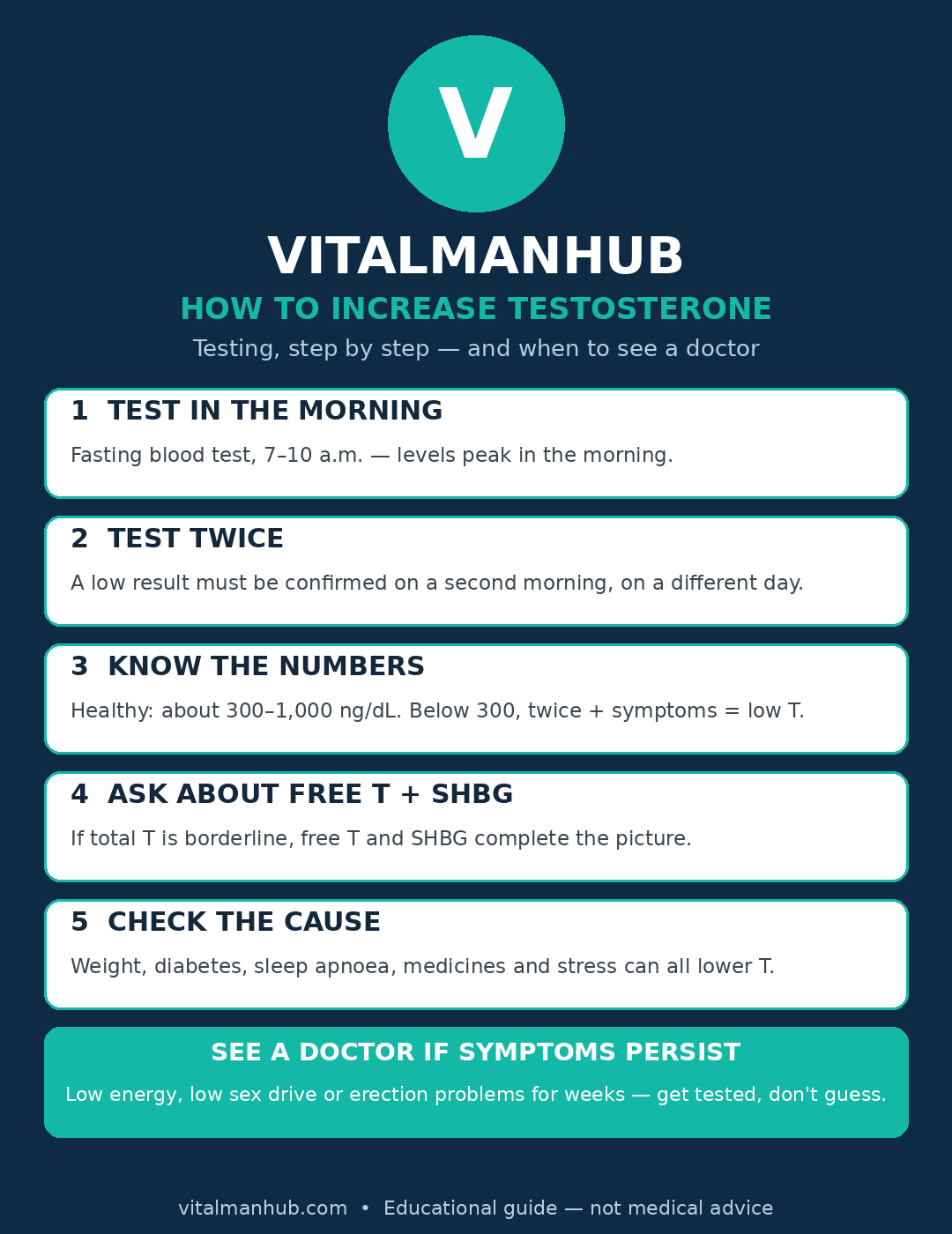
The standard first test is total testosterone. The healthy adult range is roughly 300–1,000 ng/dL, and below 300 ng/dL — confirmed twice, with symptoms present — is the usual threshold for low testosterone. If your total is borderline, your doctor may add SHBG and calculate or measure free testosterone, plus LH and FSH, which show whether the problem sits in the testicles or in the brain signals that drive them.

| Result (total testosterone) | What it usually means |
|---|---|
| About 300–1,000 ng/dL | Commonly quoted healthy adult range |
| Below 300 ng/dL, twice + symptoms | Low testosterone — the usual definition |
| 300–400 ng/dL with symptoms | Grey zone — symptoms and free T decide, with your doctor |
| One low reading only | Not a diagnosis — repeat it on another morning |
Natural Ways to Raise Testosterone — The Short Version
For most men, the first step is not a prescription. It is the foundations: sleep, training, weight, food and stress. Our full natural guide covers each one in detail — see how to increase testosterone naturally — but here is the honest summary.
Sleep 7–9 hours at regular times: most daily testosterone is made during deep sleep, and one week of five-hour nights cut daytime testosterone by 10–15% in healthy young men in a controlled study (Leproult, 2011). Lift weights 2–4 times a week with compound movements. Lose excess body fat steadily — of all lifestyle changes, meaningful weight loss usually moves testosterone the most. Eat to avoid deficiencies: zinc and vitamin D help only if you are actually low in them. And give stress a way down — a daily walk, real rest, and time with your partner without phones.
Expect weeks to months, not days. Sleep improves within a week or two; training and fat loss take 8–12 weeks to show clearly. After about three months of consistent habits, a repeat morning blood test is a fair check on whether the foundations were enough.
What About Testosterone Therapy?
Testosterone therapy — sometimes called TRT — replaces the hormone your body is not making enough of. It is a real medical treatment, and it is also one of the most misunderstood. It is for confirmed, symptomatic low testosterone: two low morning results plus symptoms, with the cause investigated. It is not for healthy men who simply want higher numbers, and it is not an anti-ageing treatment. That is why any honest guide to how to increase testosterone must separate treatment from optimisation.
The largest safety trial, TRAVERSE, published in the New England Journal of Medicine in 2023, randomised 5,246 men aged 45–80 with low testosterone and existing or high cardiovascular risk to testosterone gel or placebo. Major heart events occurred in 7.0% of men on testosterone and 7.3% on placebo — no excess. But the same trial saw more atrial fibrillation, pulmonary embolism, acute kidney injury and fractures on testosterone. On 28 February 2025 the FDA removed the cardiovascular language from the boxed warning, added a new class-wide warning about blood pressure, and kept the rule that these products are not approved for age-related low testosterone. The honest summary: the biggest heart fear did not hold up, but therapy is not risk-free.
Therapy also suppresses your own production and sperm production while you take it, so fertility is a real conversation before starting — especially for younger men. Never buy testosterone online: it is a prescription-only, controlled medicine, and self-treating is risky. If your tests confirm low testosterone, talk to your doctor or an endocrinologist about whether therapy fits and how it will be monitored.
What Does Not Work
A few things to skip, whatever the adverts promise. No food doubles testosterone. Ice baths, raw eggs and extreme routines have no human evidence of raising it meaningfully. Unregulated “testosterone boosters” can contain hidden steroid-like ingredients, and the US FDA has warned about them. Megadoses of zinc can cause nausea and copper deficiency. Dramatic results with no side effects is the red flag, not the proof.
A Simple Plan: Your Next 4 Weeks
Do not change everything at once. This plan shows how to increase testosterone step by step, in the order that matters most.
Week 1: fix sleep — same bedtime, 7–9 hours, phone out of the bedroom. Week 2: add two full-body strength sessions and a 30-minute walk daily. Week 3: protein at every meal, zinc-rich foods three times a week, cut sugary drinks. Week 4: ten minutes of quiet time daily, and one phone-free evening with your partner. Keep going for three months — and if symptoms persist, book the morning blood test and take the result to your doctor.
Conclusion
Learning how to increase testosterone is not about one secret trick. It is about knowing where you actually stand — tested properly, in the morning, twice — then giving your body the conditions it needs: deep sleep, heavy lifting, less excess fat, honest food, and a calmer life. Most men never need more than that.
Start tonight, with sleep. Add training this week. And if the tiredness, the flat mood or the quiet in your relationship is still there in a few weeks, get tested — you deserve an answer, not a guess.
Frequently Asked Questions
How can I increase testosterone?
The honest answer to how to increase testosterone is: test first, then fix the foundations. Sleep 7–9 hours, lift weights 2–4 times a week, lose excess body fat, correct any zinc or vitamin D deficiency, and keep stress down. If two morning tests still show low testosterone with symptoms, talk to your doctor about treatment.
How do I test my testosterone levels?
With a fasting morning blood test, usually between 7 and 10 a.m., repeated on a different morning if the result is low. The healthy range is about 300–1,000 ng/dL; below 300 ng/dL, confirmed twice with symptoms, is low testosterone. Your doctor may also check free testosterone, SHBG, LH and FSH.
What is a normal testosterone level?
About 300–1,000 ng/dL for total testosterone in adult men. Levels peak in the morning and fall by evening, and drift down about 1% a year from around age 30–40. One low reading is never a diagnosis on its own.
What causes low testosterone?
The most common causes are excess body fat, type 2 diabetes, poor sleep or sleep apnoea, heavy alcohol use, smoking, chronic stress, some medicines, and anabolic steroid use. Less commonly, the cause is hypogonadism — the testicles or the brain signals that control them producing too little hormone.
Is testosterone therapy safe?
The TRAVERSE trial (5,246 men, 2023) found no excess of major heart events on testosterone versus placebo, and the FDA removed the heart-risk boxed warning in February 2025 — but added a blood-pressure warning, and therapy still raised the risk of atrial fibrillation, blood clots, kidney injury and fractures in the trial. It is a treatment for confirmed low testosterone, monitored by a doctor, not a risk-free boost.
When should I see a doctor about low testosterone?
See a doctor if symptoms persist for weeks — very low energy, low sex drive, erection problems, low mood, or muscle loss despite training. A morning blood test, repeated to confirm, is the only reliable way to know, and only a clinician should start treatment.
Medical disclaimer
This article is for general educational purposes only and is not medical advice. It does not diagnose, treat, cure or prevent any disease. Testosterone levels vary between individuals and over the day, and symptoms of low testosterone can have many causes. Talk to your doctor or another qualified healthcare professional before changing your diet, starting supplements, or beginning a new exercise programme — especially if you have a medical condition, take medication, or have been told you have low testosterone. Testosterone therapy should only be started after proper testing and diagnosis by a clinician, and never bought online. If you experience chest pain, severe breathlessness or any sudden serious symptom, seek urgent medical care.
For more guides on men’s vitality, visit VitalManHub.
Pingback: Best Testosterone Booster for Men (2026)
Pingback: Best Supplements for Men: What Is Worth Taking