
Table of Contents
Introduction
Walk into any supplement shop and maca root sits near the front, usually with a label that promises desire, energy, and manhood in one scoop. It is one of the oldest names in men’s supplements — and one of the most misunderstood. The story around maca root for men is not a scam and it is not a miracle. It is a small, honest effect in one area, and a long list of claims the trials never supported.
This guide goes through maca properly: what the root actually is, the three colours that matter, what the trials found on libido, energy, and fertility, what it does to testosterone (nothing), how much the trials used, and who should leave it on the shelf. At VitalManHub, every supplement gets the same treatment: the trials first, the marketing last.
What Is Maca Root?
Maca — Lepidium meyenii, also called Peruvian ginseng — is a root vegetable from the high Andes of Peru, grown at 3,500 to 4,500 metres above sea level, where almost nothing else grows. Andean people have eaten the dried root for centuries, and it is rich in carbohydrates, fibre, protein, and minerals like iron and calcium.
What makes maca different from an ordinary root vegetable is a group of compounds found almost nowhere else: macamides and macaenes. These fatty-acid compounds are unique to maca, and researchers think they may affect desire and mood without touching hormones at all — laboratory work suggests they interact with the body’s endocannabinoid system, which helps regulate mood, appetite, and stress. No human trial has confirmed a specific mechanism, so the honest story of maca is “something happens, and we do not fully know why,” not “it boosts your hormones.” That uncertainty is why any honest guide to maca root for men starts with the trials, not the label.
Maca comes in three main colours, and the colour is not just packaging. Yellow maca is the most common and the most studied — it is the type used in most of the trials below. Red maca is smaller and sweeter, and early research links it more to prostate and bone health than to desire.
Black maca is the rarest and the most expensive, and the small amount of research on it points to sperm and memory rather than libido. Most products do not say which colour they contain; if the label says nothing, it is almost certainly yellow. None of the three has been shown to raise testosterone, and a product that charges triple for black maca is selling scarcity, not evidence.
Maca at a Glance
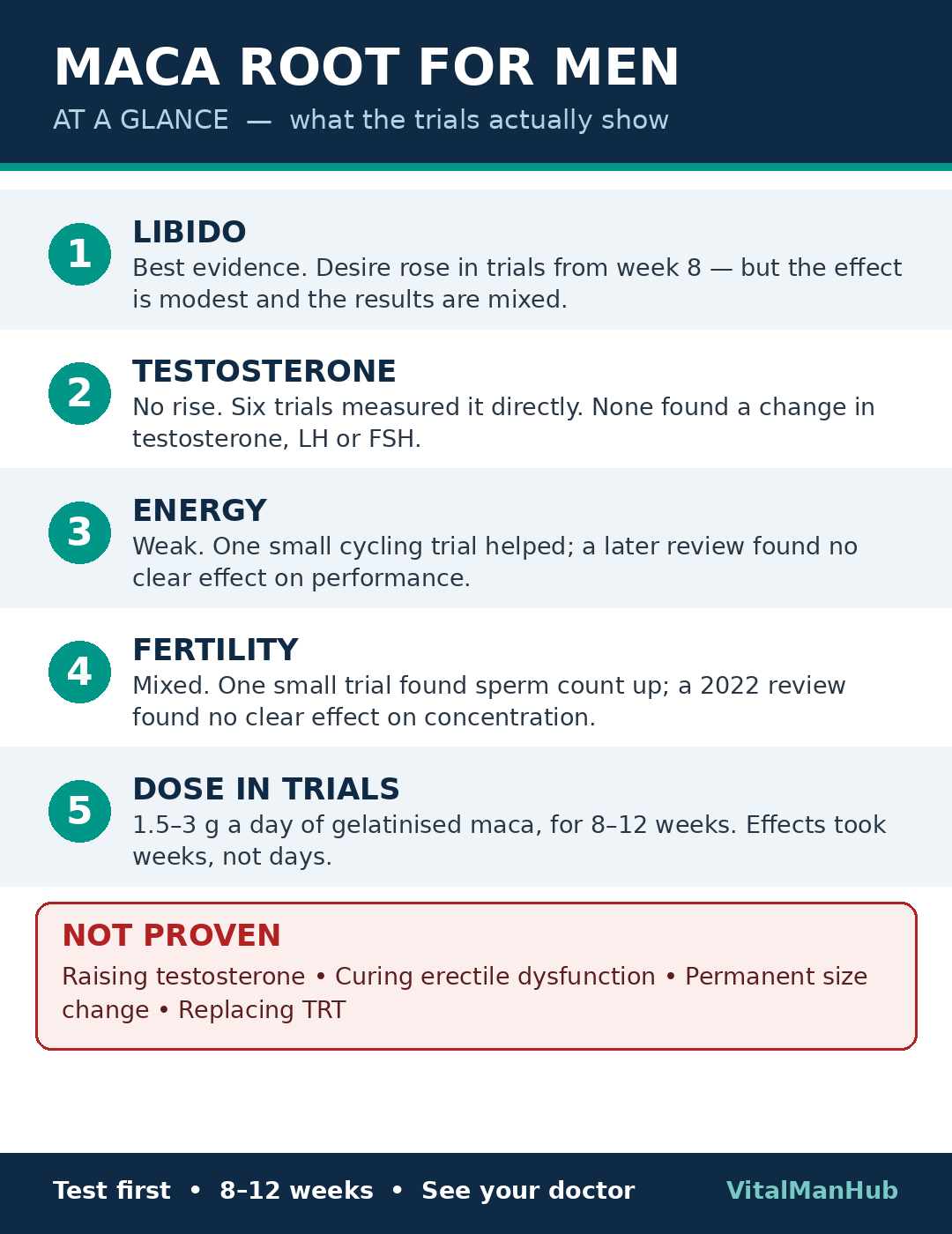
Here is what the evidence for maca root for men looks like before the detail — strongest first, weakest last.
| Area | Evidence strength | What the trials found |
|---|---|---|
| Libido / sexual desire | Best — small but replicated | Desire up from week 8 in the best trial; mixed in others |
| Testosterone | Settled — no effect | No rise in any trial that measured it |
| Energy and performance | Weak | One small cycling trial helped; a review found no clear effect |
| Fertility / sperm | Mixed | One small trial: sperm up; a 2022 review: no clear effect on concentration |
| Mood | Weak | Small mood gains in a few trials, never the main result |
The pattern is the point. Maca’s one real signal is desire — and desire is not testosterone. Keep that distinction in mind and the rest of this guide makes sense.
Libido and Sexual Wellbeing: The Best Evidence — and Its Limits
The strongest case for maca root for men is libido, and it comes from a single well-designed trial. In 2002, Gonzales and colleagues ran a twelve-week, double-blind, placebo-controlled trial in 57 healthy men aged 21 to 56. The men took 1.5 or 3 grams a day of gelatinised maca or a placebo. Self-reported sexual desire rose in the maca groups from week eight, and the effect was the same at both doses.
How far it goes is the honest part. A 2010 systematic review pooled four randomised trials of maca for sexual function and found the evidence limited: two trials showed a positive effect on desire or function, and two did not. The reviewers’ own conclusion was that the evidence was too limited — in trial number, sample size, and quality — to draw firm conclusions.
A later trial in 50 men with mild erectile dysfunction found a small but significant improvement in erection scores over twelve weeks on 2.4 grams a day, with no change in testosterone between the groups. And a small trial in men whose antidepressants had dulled their sex drive found maca at 3 grams a day improved sexual function. Each of these is a small, short trial. Together they add up to a real but modest signal, not a reliable treatment.
One more limit: the trials measured desire, not performance. Keep that limit in mind when judging maca root for men: it may raise desire, not performance. Wanting sex more and having better erections are different things, and maca’s evidence is almost entirely about the first. If the problem is erections rather than desire, maca is the wrong tool — erectile dysfunction can be an early sign of heart or blood-vessel disease, and it deserves a doctor’s appointment. The Endocrine Society publishes the guidance on hormone testing and treatment.
Testosterone: What Maca Does NOT Do
Here is the sentence that should be on every maca label but never is: maca root for men does not raise testosterone. This is not a gap in the research — it is one of the best-settled facts in this whole field.
The Gonzales trial above measured testosterone and oestradiol alongside desire and found them unchanged — the paper’s title says so outright: the effect on desire had an “absent relationship with serum testosterone levels.” A follow-up study in 2003 measured testosterone, LH, FSH, prolactin, and oestradiol at two, four, eight, and twelve weeks and found no significant change in any of them.
Four controlled trials in men have now measured testosterone against placebo and found no rise, and a 2024 systematic review of 52 studies on ingredients sold as testosterone boosters confirmed that maca did not raise total testosterone in any tested population.
That is why maca sits at the bottom of the testosterone table in our guide to the best testosterone booster for men: weak for testosterone, with mixed libido evidence. If your testosterone is low — below 300 ng/dL, confirmed twice and with symptoms, which the Cleveland Clinic explains — maca will not fix it, and taking it instead of seeing a doctor delays proper care.
Energy and Mood
The energy claim is where maca root for men marketing runs furthest ahead of its trials. The best-known result comes from a 2009 trial in eight trained male cyclists: fourteen days of maca improved their time-trial performance and was linked by the authors to a small rise in sexual desire. Eight men for two weeks is a hint, not proof — and a later systematic review graded maca as having no significant effect on physical performance. There is no good trial showing maca makes a man stronger, faster, or more enduring in any lasting way.
Mood is similar. A few trials report small improvements in mood and energy scores, usually alongside the desire effect, and the 175-person safety trial in 2016 noted better mood in the maca groups. But mood was never the main thing any trial was designed to measure, the effects were small, and they could easily follow from feeling more desire and sleeping better rather than from maca itself. If you are tired because you are stressed and badly slept, maca is a weak answer to a problem with stronger ones: sleep, training, and weight.
Fertility and Sperm: Small Trials, Mixed Results
Fertility is the area where maca root for men is most often oversold, and the evidence is genuinely mixed. The positive result comes from a 2001 trial in just nine healthy men: 1.5 or 3 grams of maca a day increased sperm volume, sperm count, and sperm motility — while, again, hormones did not change. Nine men with no placebo group proves very little on its own.
The pooled evidence is less kind. A 2022 systematic review and meta-analysis of five randomised trials found no significant effect of maca on sperm concentration versus placebo, with mixed and inconsistent results on the other semen measures. One of the pooled trials did find a higher sperm concentration, but the overall picture was too inconsistent to support a claim.
And no trial has measured what actually matters to a couple trying to conceive: pregnancy rates. Maca may help sperm numbers a little, in some men, sometimes — but any man with a fertility concern should be talking to a doctor, not shopping for a powder.
Dose and Forms: What the Trials Actually Used
If you decide to try maca root for men anyway, use the dose the trials used — not the dose on the loudest label. The trials that showed anything used 1.5 to 3 grams a day, taken for eight to twelve weeks, and the desire effect in the Gonzales trial did not appear until week eight. A product that promises results in a week is promising something no trial has shown. Give it the full twelve weeks, then judge it honestly: if nothing has changed, stop.
The form matters too. Most of the trials used gelatinised maca — maca that has been heated under pressure to break down its starch. Raw maca is harder to digest and more likely to cause stomach upset, because the raw root is about 60 to 75 percent starch. Gelatinised maca is the safer default, and it is the form the evidence covers. Capsules and powder are the same thing in different packaging — powder is cheaper per gram, capsules are easier to dose on the go.
Our guide to the best supplements for men puts maca in context, and the same buying rules apply: the label should state the colour and the form, the dose should match the trial dose, and the product should be third-party tested. A “proprietary blend” that hides how much maca is inside is not worth buying.
Side Effects and Safety
Maca is generally well tolerated, and that is one of the few things the trials agree on. The largest safety trial — Gonzales-Arimborgo and colleagues, 2016 — gave 175 adults 3 grams a day of black or red maca extract for twelve weeks and found no serious adverse effects, no changes in blood pressure, and no changes in liver or kidney markers. The Cleveland Clinic’s guide to maca root for men agrees: short-term use at trial doses looks safe for most healthy adults. For maca root for men, the common side effects are mild: stomach upset, bloating, and a taste some men dislike.
Who Should Avoid It
Some men should skip maca root for men entirely, or at least not start it without a doctor’s advice.
First, anyone with a thyroid condition. Maca is a brassica, and like other brassicas it contains glucosinolates — compounds that can interfere with iodine uptake and thyroid function in large amounts. No trial has shown thyroid harm, but if you have hypothyroidism or take thyroid medicine, ask your doctor first.
Second, anyone with a hormone-sensitive condition — including prostate problems or a history of hormone-sensitive cancer — should be cautious. Maca does not raise testosterone, but it is sold for sexual function, and any man with a prostate or hormone condition should check with his clinician before taking it.
Third, there is no safety data for maca root for men in pregnancy or breastfeeding, and maca is not recommended for children. Finally, if you are already taking medication for blood pressure, blood sugar, or mood, or you have liver or kidney disease, talk to your doctor first. The absence of known interactions is not proof that none exist — it is proof that nobody has looked very hard.
What Maca Does NOT Do
The label will not give you this list for maca root for men, so here it is.
| Claim | What the evidence actually says |
|---|---|
| Raises testosterone | No trial found a rise; four controlled trials and a 52-study review agree |
| Cures erectile dysfunction | No trial shows this; ED needs a medical work-up |
| Permanently increases size | No evidence at all; no supplement does this |
| Improves fertility reliably | Mixed trials, no effect on sperm concentration in a 2022 review, no pregnancy data |
| Boosts energy or performance | One tiny cycling trial helped; a review found no clear effect |
| Works in a week | The desire effect took eight weeks to appear in the best trial |
| Replaces testosterone therapy | TRT is a medical treatment; maca cannot turn a low result normal |
Any product that claims otherwise is selling a story, not a study.
The Bottom Line
So what is maca root for men, honestly? A Peruvian food with one real, modest effect: it may lift sexual desire a little, after eight to twelve weeks, in some men — and it does so without changing testosterone at all. That is a genuinely interesting result, and it is the whole case for maca. Energy, mood, and fertility rest on weaker, mixed evidence, and testosterone, erections, and size rest on none.
The pattern is the point. Maca helps a man whose problem is desire, not hormones. Testosterone falls about 1% a year from around age 30 to 40, as the NHS explains — a slow, normal decline is not a deficiency, and a root powder is not a treatment for one. Test first, fix sleep, training, and weight, and if you want to try it, take 1.5 to 3 grams a day of gelatinised maca for twelve weeks — then judge it honestly.
FAQs
Does maca root increase testosterone in men?
No. Four controlled trials measured testosterone directly and found no rise, and a 2024 review of 52 studies confirmed maca did not raise total testosterone in any tested population. Maca’s effect on desire is independent of testosterone — the trial that found it said so in its own title.
Does maca root help with libido?
Modestly, and not for everyone. The best trial — 57 men, 1.5 or 3 grams a day for twelve weeks — found desire rose from week eight. But a systematic review of four trials found two positive and two negative, and called the evidence too limited for firm conclusions. Expect a small effect after eight weeks, or none at all.
How much maca root should men take?
The trials used 1.5 to 3 grams a day of gelatinised maca for eight to twelve weeks. Start at the lower end, take it daily, and give it the full twelve weeks before judging it. Gelatinised maca is easier to digest than raw maca, and it is the form the trials actually tested.
Is maca root safe for men?
Short-term use at trial doses looks safe for most healthy men — a 175-person trial at 3 grams a day for twelve weeks found no serious adverse effects. Mild stomach upset and bloating are the common complaints, usually from raw maca. Men with thyroid conditions or hormone-sensitive conditions should talk to a doctor first.
Does maca root improve fertility or sperm count?
The evidence is mixed. One very small trial in nine men found sperm volume, count, and motility rose, but a 2022 review of five trials found no significant effect on sperm concentration. No trial has measured pregnancy rates. A man with a fertility concern should get a proper medical work-up rather than relying on a supplement.
Gelatinised or raw maca — which is better?
Gelatinised. It has been heated under pressure to break down the root’s starch, so it is easier to digest and less likely to cause stomach upset. It is also the form used in most of the trials, so the evidence actually covers it. Raw maca is cheaper but harder on the stomach and less studied.
Medical disclaimer
This article is for general educational purposes only and is not medical advice. It does not diagnose, treat, cure or prevent any disease.
Testosterone levels vary between individuals and over the day, and symptoms of low testosterone can have many causes. Talk to your doctor or another qualified healthcare professional before changing your diet, starting supplements, or beginning a new exercise programme — especially if you have a medical condition, take medication, or have been told you have low testosterone. Testosterone therapy should only be started after proper testing and diagnosis by a clinician, and never bought online. If you experience chest pain, severe breathlessness or any sudden serious symptom, seek urgent medical care.
For more guides on men’s vitality, visit VitalManHub.