
Table of Contents
Introduction
Ashwagandha is the most talked-about supplement in men’s health right now, and the claims around it are enormous: higher testosterone, deeper sleep, less stress, more muscle, a sharper mind, a better sex life. Some of that is true. Some of it is a small trial result stretched into a sales pitch. The benefits of ashwagandha for men are real — but they are modest, they take weeks, and they help some men far more than others.
This guide goes through the benefits one by one: what the trials actually found, how big the effect was, and who it helps most. No buying advice here — that is a separate guide — just the evidence, with its limits stated plainly. The rule here is simple: know your numbers first, sort sleep, training, and weight, and judge any supplement on its trials. At VitalManHub, every supplement gets the same treatment: the trials first, the marketing last.
The Benefits at a Glance
Here are the benefits of ashwagandha for men, ranked by how strong the evidence is — strongest first, weakest last.
| Benefit | Evidence strength | Effect size |
|---|---|---|
| Stress and cortisol | Strongest — several trials | Cortisol down ~28% in stressed adults |
| Testosterone | Moderate — small trial base | About +15% vs placebo |
| Sleep | Moderate — meta-analysis of 5 trials | Modest gains, mainly in insomnia |
| Strength and recovery | Moderate — one main trial | More strength and muscle with training |
| Energy and mood | Moderate — from the same trials | Less fatigue, more vigour |
| Focus | Weak — small, short trials | Small memory and attention gains |
| Libido and sexual health | Weakest — no direct trial | Indirect only, through stress and sleep |
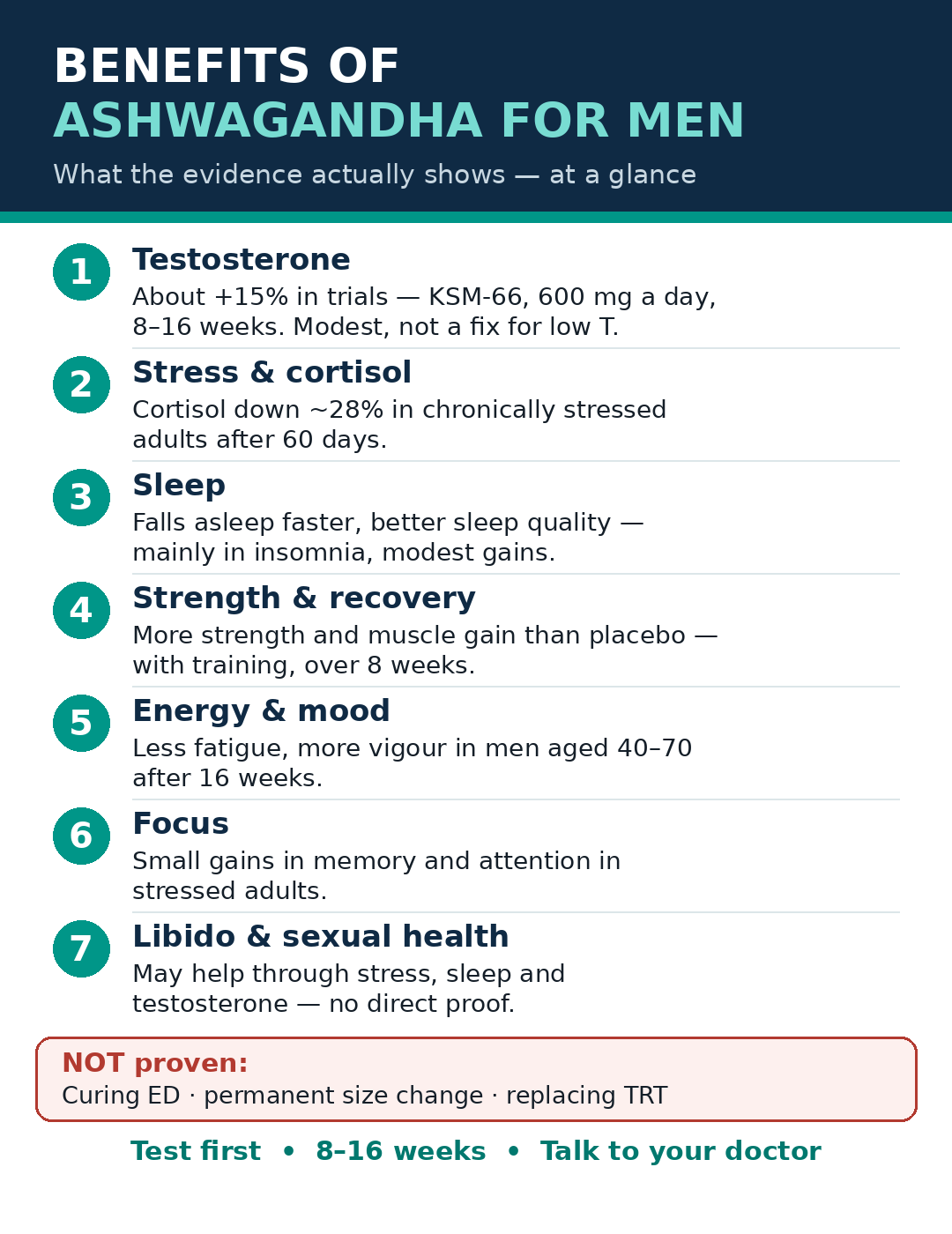
The pattern matters more than any single row: the benefits cluster around stress. Ashwagandha helps most when stress, poor sleep, or hard training is holding a man back — and least when nothing is wrong in the first place.
Testosterone: About 15% — and What That Means
The most talked-about of the benefits of ashwagandha for men is testosterone, and the number you will see everywhere is about 15%. It comes from real trials, but it needs its context.
In 2015, Wankhede and colleagues gave 57 young men on a resistance-training programme 600 mg a day of KSM-66 or a placebo for eight weeks. Testosterone rose about 15% on ashwagandha, against about 3% on placebo. In 2019, Lopresti and colleagues gave 60 overweight men aged 40 to 70 the same 600 mg a day for sixteen weeks: testosterone rose 14.7% against placebo, and DHEA-S — a hormone the body can turn into testosterone — rose about 18%. A 2023 meta-analysis pooled four trials with 234 men and found the same figure, about 14.7%.
That sounds like three independent confirmations. It is not: the meta-analysis pools the trials above, the same men counted again. It strengthens the case without adding a single new man, and no trial ran longer than sixteen weeks. In our guide to the best testosterone booster for men, ashwagandha came out ahead of the other herbal ingredients — on this same, modest evidence.
Keep the number in proportion. Fifteen percent on 400 ng/dL is about 60 ng/dL. It will not turn a low result into a normal one: if your testosterone is 250 ng/dL, ashwagandha will not make it 400. Below 300 ng/dL, confirmed twice and with symptoms, is low — the Cleveland Clinic explains the testing — and that is a medical matter, not a supplement matter.
Who it helps most: stressed men, poor sleepers, and men in hard training — the men whose testosterone is held down by pressure and poor recovery. A relaxed man with normal testosterone should expect little or nothing.
Stress and Cortisol: The Best-Supported Benefit
If there is one of the benefits of ashwagandha for men that the trials support clearly, it is stress. Ashwagandha is an adaptogen — a substance said to help the body handle stress — and here the word actually has trial data behind it.
In a 2017 trial, 64 chronically stressed adults took 300 mg of KSM-66 twice a day for sixty days. Cortisol — the stress hormone — fell 27.9%, against 7.9% on placebo, and perceived-stress scores fell with it. Other trials in stressed adults point the same way: lower stress scores, lower anxiety scores, and a calmer day-to-day feeling.
This is also the most likely explanation for the testosterone result. When stress stays high for weeks, cortisol stays high with it, and cortisol brakes testosterone production — partly by suppressing the brain signals that tell the testes to work. Ashwagandha loosens that brake. That is why the biggest testosterone rises show up in stressed men: in a man with nothing to release, there is no brake to loosen.
Who it helps most: men under sustained pressure — demanding work, broken sleep, constant worry — who feel wired and tired at the same time. Expect a calmer baseline over weeks, not a calm afternoon after one capsule.
Sleep: Falling Asleep Faster, Sleeping Better
One of the quieter benefits of ashwagandha for men is sleep, and it may be the one men notice first. A 2021 meta-analysis pooled five small sleep trials and found ashwagandha improved sleep quality and shortened the time it takes to fall asleep — by a modest amount, and mainly in people with insomnia. The US National Center for Complementary and Integrative Health agrees: some preparations may help insomnia and stress.
The effect is probably tied to the last section. Lower evening cortisol and a calmer nervous system make it easier to switch off, and drowsiness is a real, reported effect of ashwagandha — which is why it is usually taken in the evening. Do not drive until you know how it affects you.
Who it helps most: men who lie awake with a racing mind, or who wake unrefreshed after a short night. If your sleep is already good, expect little change — and if your sleep problem is snoring, apnoea, or shift work, ashwagandha does not fix the cause.

Strength and Muscle Recovery
Another of the benefits of ashwagandha for men that only shows up with training is strength. In the Wankhede trial above, the men on ashwagandha gained more strength and muscle size than the placebo group over eight weeks of identical training. The likely reason is recovery: less cortisol and better sleep between sessions let a man train harder, more often.
Read it as a training result, not a muscle drug. Every man in that trial was lifting weights, and ashwagandha most likely helped them recover — it did not build muscle on its own. No trial has shown strength gains in men who do not train.
Who it helps most: men already on a consistent lifting programme who feel run down between sessions. If you are not training, this benefit does not exist for you.
Energy and Mood
The benefits of ashwagandha for men on energy and mood are real but indirect — they follow from the stress and sleep effects above. In the Lopresti trial of men aged 40 to 70, fatigue fell and vigour improved over sixteen weeks, alongside the testosterone rise. Stressed adults in other trials reported the same pattern: less exhaustion, a steadier mood, more get-up-and-go.
Nothing here suggests ashwagandha is a stimulant. It does not give energy the way caffeine does; it removes some of what drains energy — chronic stress and bad sleep — and the energy returns on its own. That is a slower, quieter effect, and it is easy to miss if you are looking for a jolt.
Who it helps most: tired, stressed men in their forties and beyond, whose low energy tracks with poor sleep and constant pressure. A man who is already sleeping well and unstressed is unlikely to feel a difference.
Focus: The Weakest Evidence So Far
The least proven of the benefits of ashwagandha for men is focus. The evidence here is thin: a few small, short trials, mostly in stressed adults, reporting small gains in memory and attention. One small eight-week trial in 50 adults with mild memory problems found improved immediate and general memory on ashwagandha against placebo — but 50 people for eight weeks is a hint, not proof, and the trial was not in men specifically.
Be honest about what this means. Ashwagandha is not a focus drug, and no trial has shown it sharpens a healthy, well-rested mind. Any focus benefit most likely comes from the same route as the rest — less stress, better sleep — rather than a direct effect on the brain.
Who it helps most: stressed, badly slept men who feel foggy — and even then, expect a small change. If focus is the main reason you are considering it, sleep and stress management will do more, faster.
Libido and Sexual Health: An Honest Look
The most searched-for of the benefits of ashwagandha for men is also the least proven: libido and sexual health. Here is the honest position — there is no good trial showing ashwagandha directly improves libido or erections in men.
What exists is indirect. Stress, poor sleep, and low testosterone all drag libido down, and ashwagandha helps all three a little — so a stressed man may find his sex drive returns as his stress falls and his sleep improves. There is also one small fertility trial: 46 men with low sperm counts took KSM-66 for 90 days and saw sperm count and motility rise, alongside a testosterone rise of about 17%. That is about fertility, not desire, and 46 men is a small base.
What ashwagandha does not do matters more: it does not cure erectile dysfunction, and erectile dysfunction can be an early sign of heart or blood-vessel disease. A man with persistent erection problems should see a doctor, not buy a supplement. The Endocrine Society publishes the guidance on hormone testing and treatment — low testosterone with symptoms is a medical diagnosis, and it deserves a medical work-up.
Who it helps most: a stressed, poorly slept man whose low libido tracks with his stress. If the problem is persistent, physical, or worrying, that is a doctor’s appointment, not a bottle.
What Is NOT Proven
The label will not give you this list of the benefits of ashwagandha for men, so here it is.
| Claim | What the evidence actually says |
|---|---|
| Cures erectile dysfunction | No trial shows this; ED needs a medical work-up |
| Permanently increases size | No evidence at all; no supplement does this |
| Replaces testosterone therapy | TRT is a medical treatment; ashwagandha cannot turn a low result normal |
| Works in a week | Trials ran 8–16 weeks; nothing suggests an effect in days |
| Builds muscle without training | Strength gains only appeared in men who were training |
| Fixes low testosterone from illness or medication | No trial covers this; the cause needs a doctor |
Any product that claims otherwise is selling a story, not a study.
Who Benefits Most — and Who Should Skip It
Put together, the benefits of ashwagandha for men add up to a clear picture. It helps most the man whose testosterone is held down by stress and poor recovery: sustained pressure, bad sleep, hard training, a low-normal level with a stressful life behind it. The over-40 men in the Lopresti trial fit that picture, and they saw the clearest rises.
It helps least the man without that problem: healthy, low-stress, well-slept, with normal testosterone. Age alone is not a reason — testosterone falls about 1% a year from around 30 to 40, as the NHS explains, but a slow, normal decline is not a deficiency.
Some men should skip it entirely. The Cleveland Clinic’s guide to ashwagandha sets out the cautions: do not take it in pregnancy, with hyperthyroidism, or alongside sedatives, sleeping pills, or alcohol without a doctor’s advice. Rare liver injury has been reported — stop and see a doctor promptly for yellowing skin or eyes, dark urine, or persistent nausea. Tell your doctor if you take blood-pressure, blood-sugar, or thyroid medicine, or have liver, thyroid, or prostate problems. If you decide it is worth trying, our guide to the best ashwagandha for men explains how to choose a named extract at the studied dose.
The Bottom Line
So what are the benefits of ashwagandha for men, honestly? A modest testosterone rise of about 15% in the right men, a real fall in stress and cortisol, a little better sleep, a little more strength with training, a little more energy — and a lot less than the label promises. Focus and libido rest on the thinnest evidence of all.
The pattern is the point: ashwagandha helps when stress, sleep, or recovery is the problem. Fix those foundations first — sleep, training, weight — then, if you want to try it, test your testosterone, take a named extract at the studied dose for eight to sixteen weeks, and retest. Then you will know, from a blood test and not a feeling, whether it did anything for you.
FAQs
What are the main benefits of ashwagandha for men?
The best-supported benefits are lower stress and cortisol, a modest testosterone rise of about 15%, better sleep, and more strength with training. Energy and mood improve indirectly through stress and sleep. Focus and libido have the weakest evidence — small trials only, and no direct proof for libido.
Does ashwagandha increase testosterone?
Yes, modestly, in the right men. Trials of KSM-66 at 600 mg a day found testosterone rose about 15% against placebo over 8–16 weeks. That is about 60 ng/dL on a level of 400 ng/dL — it will not turn a low result into a normal one, and it helps most in stressed men, poor sleepers, and men in hard training.
How long does ashwagandha take to work?
Give it eight to sixteen weeks, then check with a morning testosterone test. The trials that showed any benefit ran for eight to sixteen weeks, and nothing suggests an effect in days. If your number has not moved after sixteen weeks, the product is not working for you.
Does ashwagandha help with sleep?
Yes, modestly. A 2021 meta-analysis of five small trials found it improved sleep quality and shortened the time to fall asleep, mainly in people with insomnia. It is usually taken in the evening, because drowsiness is a real effect — do not drive until you know how it affects you.
Does ashwagandha help with libido or erectile dysfunction?
There is no good trial showing it directly improves libido or erections in men. It may help indirectly, because stress, poor sleep, and low testosterone all drag libido down. It does not cure erectile dysfunction — persistent erection problems deserve a doctor’s appointment, as they can be an early sign of heart or blood-vessel disease.
Is ashwagandha safe for men to take every day?
Most men tolerate it well at the doses used in trials, but it is not safe for everyone. It can cause drowsiness and stomach upset, rare liver injury has been reported, and it can raise thyroid activity and add to the effects of sedatives and blood-sugar medicines. Talk to your doctor first if you take any regular medication or have liver or thyroid problems.
Medical disclaimer
This article is for general educational purposes only and is not medical advice. It does not diagnose, treat, cure or prevent any disease. Testosterone levels vary between individuals and over the day, and symptoms of low testosterone can have many causes. Talk to your doctor or another qualified healthcare professional before changing your diet, starting supplements, or beginning a new exercise programme — especially if you have a medical condition, take medication, are pregnant or breastfeeding, or have been told you have low testosterone.
Testosterone therapy should only be started after proper testing and diagnosis by a clinician, and never bought online. If you experience chest pain, severe breathlessness, yellowing of the skin or eyes, dark urine, or any sudden serious symptom, seek urgent medical care.
For more guides on men’s vitality, visit VitalManHub.